Static vs Dynamic O Ring Sealing Guide | Yida
Content prepared by sunyihan
Dalian Yida Precision Rubber Products Co., Ltd.
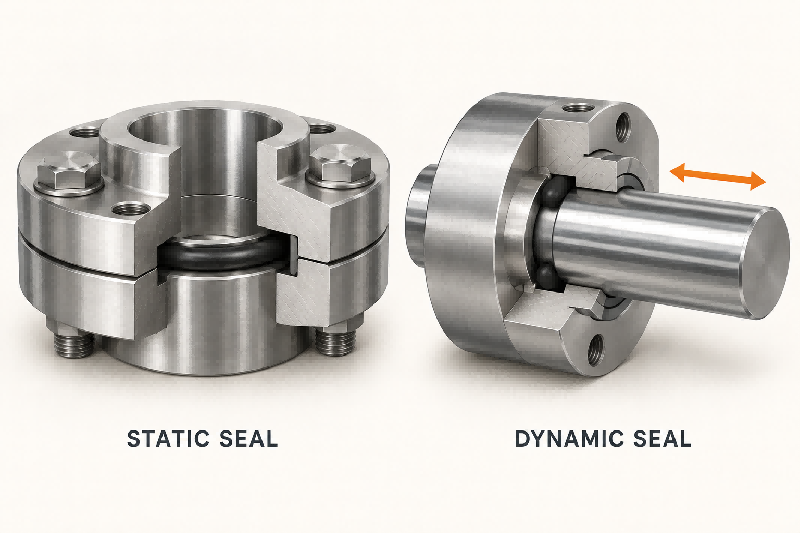
The same O ring specification can sometimes work in both applications. That can simplify purchasing, but a ring that seals a fixed cover still needs checking before it is used against a moving surface.
Consider an oil-filled cylinder. At the cover, the ring stays between two surfaces. At the piston, it has to keep sealing while sliding along the bore. Static sealing mainly asks the ring to maintain contact; dynamic sealing adds repeated rubbing, starting resistance and wear.
Matching the ring dimensions is a useful starting point. It does not tell the buyer whether the piston will move freely or whether the ring will remain in good condition after repeated strokes.
Check the Two Groove Drawings
There is a reason to review the cover groove and piston groove separately. Compression creates sealing contact, but it also affects how strongly the rubber presses against the mating surface. Extra compression that seems harmless in a fixed joint may make a moving part harder to operate.
Parker discusses this trade-off in its handbook: excessive squeeze in reciprocating service can increase friction and wear, and sometimes cause the ring to twist and fail. Making a groove tighter to stop leakage therefore needs more thought than simply choosing a larger cross-section. Parker O-Ring Handbook, Section 5.9.
Groove design also has to account for the dimensional limits of the ring and hardware. Review the tightest and loosest combinations, rather than relying on nominal dimensions alone.
ISO 3601-2:2025 is a housing-dimension reference for general hydraulic and pneumatic applications within its scope. It helps with the geometry; it does not establish the operating force or wear life of the finished assembly. ISO 3601-2:2025.
Check the rod or bore finish and lubricant alongside the drawing. A surface that looks polished is not enough evidence that it will retain suitable lubrication, and a rough surface may damage the rubber. Minnesota Rubber & Plastics design guidance.
Hardness Can Change the Force Needed to Move
A published Apple Rubber comparison gives a useful example. In 2022, the company tested AS568-010 rings in an ARP-1233 groove and bore. When it compared nitrile compounds at 40, 50, 70 and 90 durometer, the harder grades gave higher force readings in that setup.
The company also tested a temporary assembly lubricant, P-80, and reported lower insertion and actuation forces. These are Apple Rubber’s results from a controlled comparison, not Yida production data. Apple Rubber force comparison.
For a buyer considering a harder replacement ring, seal friction deserves attention even if the size remains unchanged. The assembly may need more force to start moving. Lubricant used during fitting may help installation without providing lubrication for the whole service interval.
The type of movement matters too. Reciprocating seals move back and forth; continuous rotation brings a different duty. Trelleborg limits its general O ring guidance for dynamic applications to moderate service conditions, with speed and pressure among the restrictions. An occasional sliding movement is not a useful substitute for a continuous-running test. Trelleborg Static Seals catalogue.
Before Combining the Stock Codes
Keep the material reference, hardness and dimensional tolerances fixed during approval. Otherwise, a result obtained with one compound may be used to justify a different ring delivered later.
Test the cover joint for leakage at the required pressures and temperatures, including after the agreed conditioning. For the moving location, include starting force after a period at rest, running force and leakage during movement. Run representative cycles, then inspect the ring and its mating surface for damage.
Agree the limits before testing. The same part number can be approved for both positions if both sets of requirements are met. A stationary pressure-hold result alone does not answer the movement question.
This also means using new rings made to the approved specification, not transferring a used ring from one position to another.
For a Yida inquiry, send the drawings for both locations and identify the fluid, temperature range and pressure. For the moving part, add stroke or rotation details, speed, expected life and any operating-force limit. That gives the project discussion enough detail to assess whether one specification is worth pursuing.