NBR O Ring Swelling in Oil: Acceptance Guide | Yida
Content prepared by sunyihan
Dalian Yida Precision Rubber Products Co., Ltd.
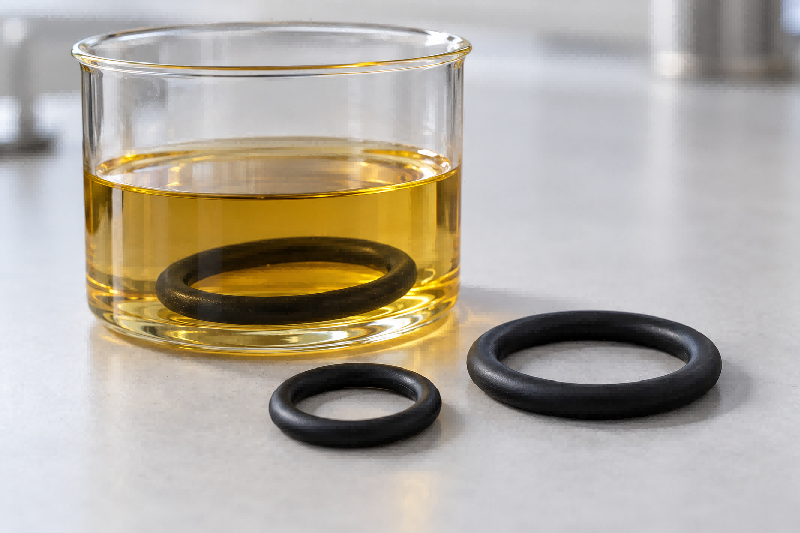
A supplier reports +8% volume change after an oil-immersion test. Whether that passes depends on the requirement agreed for the part. If the specification allows no more than +5% under the same test conditions, the result fails, regardless of how the ring looks.
There is no single acceptance limit for NBR O ring swelling in oil. For nitrile O rings, the review needs to cover the compound, the oil and the joint in which the seal will be used.
Reading an 8% Swelling Result
An 8% increase in volume does not mean the ring’s diameter or weight has increased by 8%. These are different measurements.
Volume change (%) = (volume after immersion − initial volume) ÷ initial volume × 100.
Take a hypothetical result: a 70 Shore A NBR compound shows +8% after 70 hours at 100°C. That description still leaves out the oil. It also needs to identify the compound, specimen and measurement procedure before it can be compared with another supplier’s report.
The acceptance limit should be settled before the test. Otherwise, the buyer and supplier may interpret the same result differently.
A Moving Seal Has More to Contend With
Parker’s handbook gives general guidance of up to 30% volume swell for static applications and roughly 10–15% for dynamic applications, unless the groove has been designed to accommodate more. These are rules of thumb, not guaranteed limits for every NBR compound. Parker O-Ring Handbook, Section 2.4.10.
In a moving joint, swelling can increase friction, while softening can reduce wear resistance. Checking for leakage alone may therefore miss a developing problem.
For rubber O rings, the available groove space also needs checking. A percentage that looks manageable in one assembly may leave too little room in another.
Put the Result Against the Groove Dimensions
A simple calculation helps illustrate the difference.
Suppose the ring initially occupies 85% of the groove volume. An 8% increase in rubber volume would raise the estimated fill to:
85% × 1.08 = 91.8%
If the initial fill were 90%, the same calculation would give 97.2%.
These are illustrative calculations, not test results. They assume uniform swelling and an unchanged cavity; thermal expansion, dimensional tolerances and confinement still need to be considered in the design review.
The same swelling percentage leaves very different amounts of free space. This calculation assumes an unchanged cavity and uniform free swelling; it ignores thermal expansion, tolerances and the effects of confinement. It is not a complete groove-design check.
Lower swelling is not automatically a better overall result, either. Review shrinkage, hardness and retained mechanical properties as well. A small net volume change does not show that the material has remained unchanged.
Read the Other Results Beside the Swelling Figure
For an NBR oil resistance test, the report should identify the liquid, exposure temperature and duration, specimen type and measurement conditions. Results from a reference oil and the equipment’s working oil should not be treated as interchangeable.
ASTM D471 volume change data helps compare the effects of liquid exposure. ASTM explicitly cautions that its results may not correlate directly with actual part performance. ASTM D471.
ISO 1817:2026, published in August 2026, likewise evaluates properties before and after immersion in reference or service liquids. It is a test method, not a blanket approval of a seal for an application. State the edition required by the customer’s specification. ISO 1817:2026.
| Result | What it helps assess | What it cannot prove alone |
|---|---|---|
| Volume change | Expansion or shrinkage after exposure | Leak-tight operation |
| Hardness change | Softening or hardening | Acceptable overall material condition |
| Tensile strength and elongation changes | Retention of mechanical properties | Service life in the assembly |
| Functional seal test | Performance under the tested conditions | Performance under every operating condition |
A published 2017 NBR study illustrates why these additional measurements matter. During accelerated hydraulic-oil ageing at 110°C, 130°C and 150°C, hardness initially fell and later increased, while elongation declined. These were research conditions, not recommended operating temperatures. Accelerated Aging Behavior of Nitrile-Butadiene Rubber in Hydraulic Oil.
The purchasing implication is that one short immersion result should not be presented as proof of long-term durability.
Before Approving the Order
Agree the following with the supplier:
The compound and actual oil, including product grade and relevant concentration.
The NBR oil resistance test method, conditions and acceptance limits.
The groove dimensions, tolerances, pressure and any movement.
The additional property checks and functional tests required.
Then move from immersion screening to production-intent samples: condition the rings, run representative hot and cold operating cycles, measure leakage and operating force where relevant, and inspect the parts afterward. Define the sequence and limits before testing.
For custom O rings, send Yida the drawing or dimensions, oil name, minimum/normal/maximum temperatures, pressure and expected life. Include any existing report so the inquiry can identify the material options and tests that still need confirmation.
You can also consult Yida’s O ring product range and custom manufacturing information when preparing the inquiry.
The practical question is not whether +8% sounds small. It is whether that result meets the agreed specification and whether the finished seal still performs after the relevant exposure.