Ozone-Resistant Rubber Selection: A Comprehensive Assessment of Epdm Gaskets
Actually, the real risk of cost for makers of industrial seals and automotive parts does not come from changing prices on the market, but from the hidden costs that are the times linked to the cost-cutting measures. Having been a leading supplier of rubber raw materials for more than 30 years, one thing that has become clear to us is that the majority of failures of products are caused by overestimating the performance capability of the rubber material. On this page, we discuss EPDM rubber gasket, if you are planning to get a rubber material resistant to extreme temperatures and ozone exposure.
Introducing EPDM Gaskets:
The excellent qualities of EPDM gaskets chiefly come from their saturated main chain—more specifically, the fact that there are no double bonds in the molecular skeleton—which makes them inert to ozone, oxygen, UV radiation and even polar chemicals.
Accelerated weathering tests of natural and synthetic rubbers show that exposure to outdoor elements (UV, temperature, humidity) as well as high dose ozone leads to the formation of cracks after a few weeks of normal use. In contrary, the best graded EPDM gaskets can be run cyclically for more than 2,000 hours at ozone concentration of 50 pphm without occurrence of crack.
This chemical stability is exactly why EPDM has become the number one material for outdoor and semi-outdoor uses, e.g., automotive water and weather seals; roofing membranes for waterproofing; and transformer lid seals, among others.
Comparing EPDM Gaskets with Common Ozone-Resistant Rubbers:
During the actual material selection process, engineers frequently compare EPDM with VMQ (Silicone Rubber).
| Performance Dimension | EPDM Gaskets | VMQ (Silicone Rubber) |
| Ozone Resistance (Static) | Immune to high concentrations of ozone, making it the preferred material. | Ozone resistance is stable, but decreases at high temperatures. |
| Ozone Resistance (Dynamic) | Superior crack growth resistance compared to other general-purpose rubbers. | Tensile strength is low, prone to tearing. |
| Resistance to Mineral Oil/Fuel | Rapidly swells and drastically degrades physical properties upon contact with mineral oil, fuel oil, and lubricating grease. | Suitable only for oil-free or silicone oil-based environments. |
| Compression Set (125°C) | Excellent, suitable for long-term pressure applications. | Pressure deformation is controllable at high temperatures, but resilience is weak, unsuitable for high-pressure dynamic sealing. |
| Operating Temperature Range | -45°C ~ 150°C. | -60°C ~ 230°C. |
| Unit Price (Relative) | Medium. | 2-4 times stronger than EPDM gaskets. |
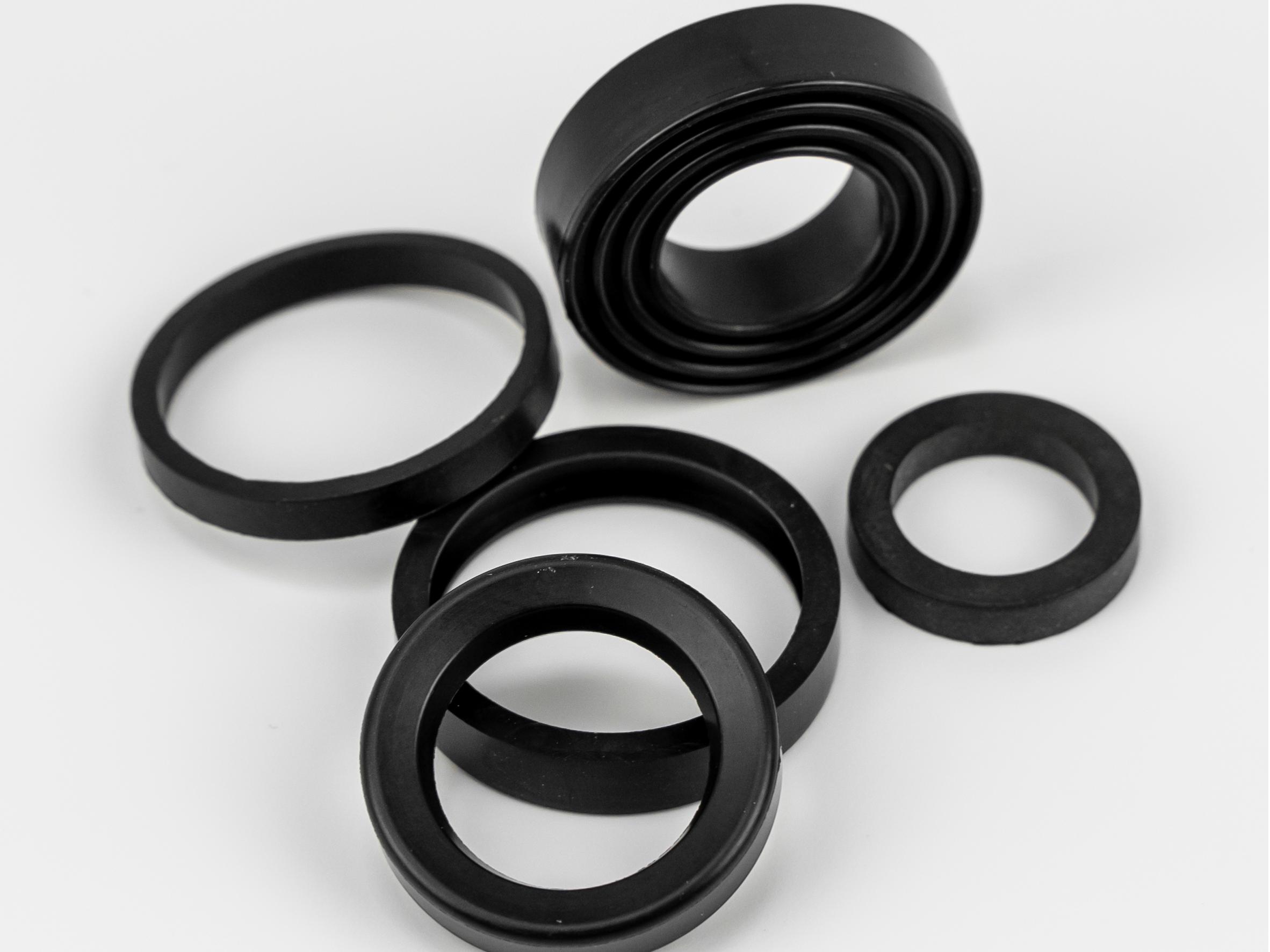
Three Common Misconceptions in Selecting EPDM Gaskets.
In actual procurement and application, the following misconceptions often lead to a paradoxical situation where "the material is technically correct, yet the product fails":
Misconception 1: EPDM Gaskets Can Replace All Weather-Resistant Rubbers.
EPDM gaskets are not resistant to mineral oils, fuels, or greases of any kind. If a sealing component is required to be in contact with both ozone and oil mist simultaneously, EPDM gaskets will swell rapidly and fail; in such cases, Chloroprene Rubber (CR) or Fluorocarbon Rubber (FKM) should be selected instead.
Misconception 2: Vulcanization Systems Can Be Switched Arbitrarily.
EPDM gaskets can be vulcanized using either the sulfur-based system or the peroxide-based one. Sulfur-cured systems provide a longer fatigue life and are cheaper, but they result in a high compression set at elevated temperature. On the other hand, peroxide-cured systems are better in terms of heat resistance and have a lower compression set, but their dynamic fatigue properties are weaker and besides these, the price is 20–30% higher.
The choice has to be dictated by the real working conditions of a machine (in particular, whether the element is always under pressure or if on the contrary it is exposed to a high-frequency stress of a dynamic nature); in fact, these systems should neither be mixed nor substituted for each other without the necessary knowledge and coin.
Misconception 3: EPDM Gaskets with Identical Hardness Are Interchangeable.
Hardness is just one of the basic parameters. Even when two different types of EPDM gaskets with the same hardness level, for example, 70 Shore A, they can still be vastly different in other aspects like tensile strength, tear strength, elasticity, and the ability to retain their performance properties after being subjected to heat aging.
Typical Application Scenarios for EPDM Gaskets.
Given the specific performance characteristics of EPDM gaskets, they offer irreplaceable advantages in the following application scenarios:
| Application Areas | Typical Products | Key Requirements |
| Automotive Exterior Sealing | Car door sealing strips, sunroof sealing strips, window guide channels | Dynamic ozone resistance, low friction, fatigue resistance, and resistance to temperatures as low as -40°C |
| Industrial Sealing | Pipe gaskets, pump and valve seals, water tank sealing rings | Low-voltage transformer, resistant to hot water, acids, and alkalis, leak-proof even after long-term compression |
| Building Waterproofing | Roofing EPDM gaskets waterproof membrane, expansion joint waterproofing strips | Outdoor weather resistance for over 20 years, UV resistance, and ozone resistance |
| Power and Electrical Equipment | Transformer top cover seals, cable accessories, insulating gaskets | High insulation, high temperature resistance, low-voltage transformer, and long-term maintenance-free operation |
| Water Treatment and Sanitary Ware | Pump body seals, shower hose connectors, faucet gaskets | Resistant to chlorine water and hot water, odorless, and meets drinking water standards |
EPDM gaskets are commonly used as engineering materials in applications that are resistant to ozone.
Choosing the right one will result in the lowest total lifecycle cost; on the other hand, a wrong decision may cause hidden expenses that are significantly higher than just the price difference of the materials.
Being a leading supplier in rubber raw materials for the past 30 years, we advise manufacturers to set up a closed-loop selection process - from operating condition analysis and material matching to testing and validation.
If you want an EPDM gasket designed for specific operating conditions (temperature, media, dynamic frequency, expected life), feel free to reach out to our technical team.EPDM gaskets are commonly used as engineering materials in applications that are resistant to ozone.