Selection Guidelines for Nitrile Rubber NBR O Rings
In industries, such as industrial equipment maintenance and sealing applications, the smallest O-ring is often overlooked until it causes incidents like equipment leaks or production losses through its failure.
The fact that nitrile (NBR) rubber sealings are one of the primary sealing materials has become a common knowledge.Because it is such a significant component, merely choosing the material will greatly influence the safety levels and the maintenance costs of the complete machine.
Why Are Nitrile Rubber NBR O Rings the Preferred Choice for Industrial Sealing?
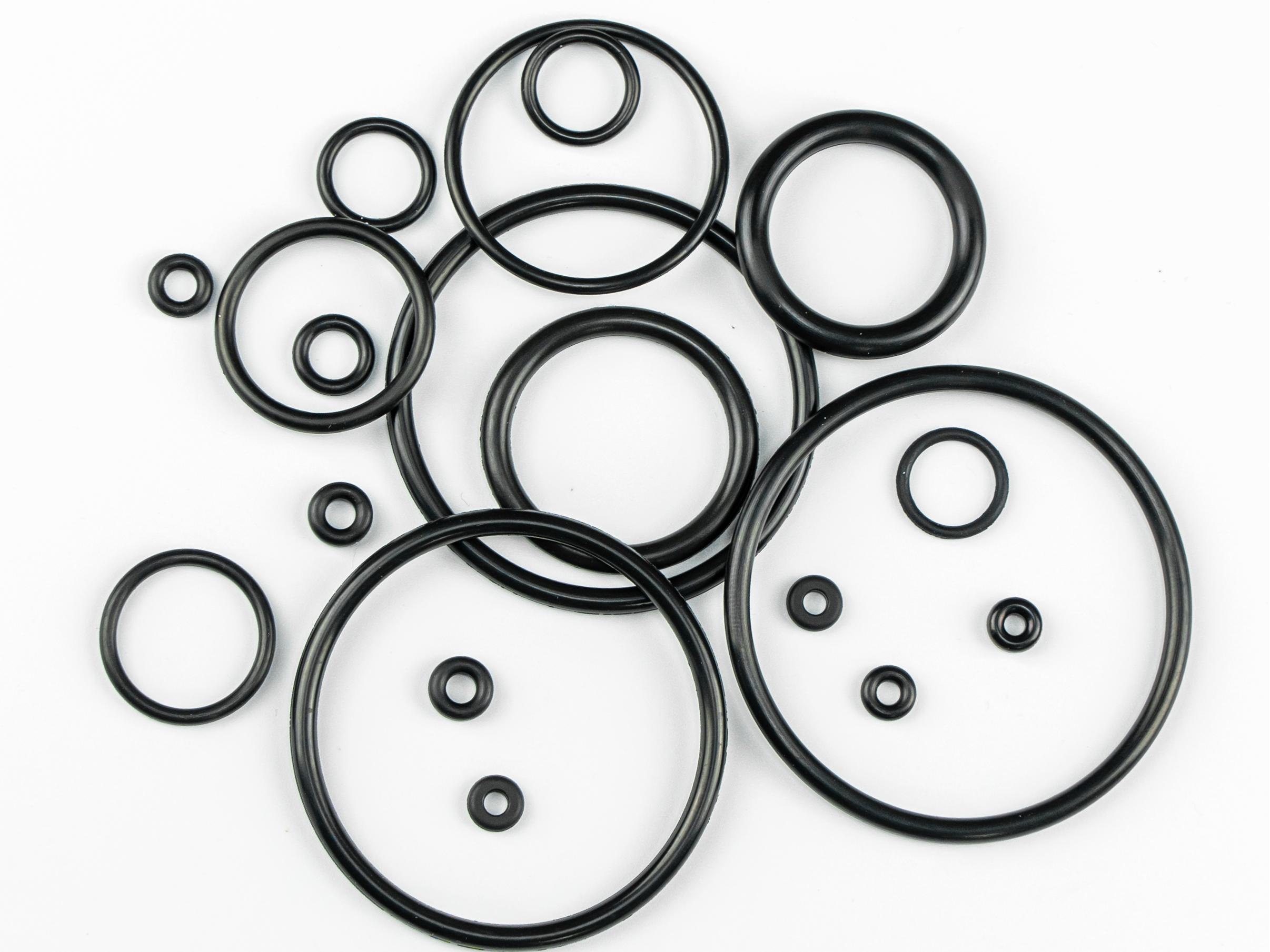
Nitrile rubber NBR O rings have become the preferred material for sealing in a variety of applications, including hydraulic systems, fuel lines, and pneumatic equipment, due to their excellent oil resistance, durability, and reasonable prices. Below, you will find the main performance characteristics of the rubber material:
| Item | Composition |
| Material | Copolymer of Butadiene and Acrylonitrile (ACN) (Customizable) |
| Size Range | Inner Diameter: 1.78 mm – 500 mm; Cross-Sectional Diameter: 1.78 mm – 12.7 mm |
| Shape | Customizable according to client requirements |
| Color | Black (Standard); other colors available upon request |
| Surface Requirements | Surface Finish: Ra ≤ 1.6 μm, free of surface defects |
| Temperature Resistance Range | Temperature Range: -40°C to +120°C (Short-term peak: 130°C) |
| Hardness | Hardness: Shore A 70±5 (Standard), 80±5, 90±5 — adaptable to various sealing pressure requirements |
Note: The use of nitrile rubber (NBR) O-rings, such as the n-butadiene-based ones, is discouraged when dealing with ketones (e.g. acetone), esters, brake liquids, ozone-environments, and cases involving UV light.
In case your machines operate under the influence of the media or environments mentioned above, FKM or EPDM materials might be more suitable.
An Essential Metric, Often Missed.
Purchasing officers who don't know much can look only at an O-ring's size and materials and completely forget, hardness, which is one of the primary indicators, that seal will serve.
1. Hardness: 70 Shore A.
Applying 0-1500 psi pressure range in a sealing situation which requires the least sealing and dynamic ones that don't require much pressure. Its great elastic memory, ease of installation, and adaptability to surface irregularities are all great advantages of this product.
2. Hardness: 80 – 90 Shore A.
Designed for very high hydraulic pressure systems and situations where extrusion resistance is very important (pressure range > 1500 psi). Its rigidity and excellent extrusion resistance at high pressure are the features that make this seal a very good choice.
Operating Condition Matching — A Comprehensive Assessment of Temperature, Media, and Pressure.
1. Temperature.
The range of -40°C to +120°C represents the absolute limit for nitrile rubber NBR O ring; it is not the recommended range for continuous, long-term operation. For engineering selection purposes, the recommended temperature range for continuous use is -30°C to +100°C. If your equipment is expected to operate continuously in environments exceeding +150°C, you should switch to FKM materials.
2. Media Compatibility.
If you select a wrong material, the sealing ring may not be compatible with the media it is exposed, that may cause increase of volume, softening and finally total loss of sealing ability of the O-ring. Nitrile rubber is usually compatible with media such as mineral oil-based hydraulic fluids, diesel fuel, gasoline, and lubricating oils. The use of Nitrile in conjunction with phosphate ester-based hydraulic fluids, ketones, ester-based solvents, or brake fluids is not recommended.
Size Standards – Why Do Size Inconsistencies Lead to Leaks?
The specification for nitrile rubber NBR O-rings must strictly follow international standards. Their major constituents are:
1.Compression rate (static seal 15%-30%, dynamic seal 10%-15%): it decides the sealing force.
2.Elongation rate: Over elongation at installation time will decrease the effective section and speed up the aging process.
3.Groove fiiling rate (static seal 65%-85%, dynamic seal 60%-80%): A thermal expansion allowance is given.
Storage and Shelf Life - Expired Rubber Needs to Be Replaced Promptly.
Rubber materials age over time (even when not used). Generally, the shelf life of nitrile rubber NBR O rings is 5-15 years when properly stored. Storage condition requirements:
Avoid light (ultraviolet rays will destroy the molecular structure of NBR).
Keep away from motors and welding machines (ozone generators).
The temperature is below 30℃ and the humidity is moderate.
Expiration judgment:
If white frost appears on the surface - it can usually still be used.
Cracks appear during bending - it has expired and must be scrapped.
Feels hardened and loses elasticity - should not be used.
Procurement Pitfall Guide: 7 Common Mistakes and Their Consequences.
According to industry failure statistics, the following 7 errors are the primary causes of failure in nitrile rubber NBR O rings:
1. Switching NBR to FKM in a high-temperature environment: Causes the rubber to deteriorate due to heat, making it hard and brittle.
2. Using 70A hardness rubber in the high-pressure system where the requirement is higher hardness: The seal gets extruded into the clearance gap due to the excessive pressure.
3. Mixing Imperial and Metric sizing: The inaccuracy in compression ratios causes leaks and makes the installation difficult.
4. Not verifying the manufacturing date code: Old or expired rubber will lead to the failure of the seal sooner than expected.
5. Not considering the fluid with which the seal comes in contact: The seal will swell up quickly and thus fail.
6. Operating at high pressure with seals only (no backup rings): The seals get pushed into the clearance gap leading to severe leakage.
7. Very little or no lubrication at the time of assembly:
This will lead to extra friction which, in turn, causes the seal to move or wear out considerably.
Expert Selection Drives Procurement Decisions.
For both domestic and international buyers, selecting the appropriate nitrile rubber NBR O ring is a systematic process involving materials science, mechanical design, and operational condition analysis. Practical Recommendations:
1.Develop an extensive datasheet where all the operational parameters are specified before ordering.
2. Ask for a material certification from the supplier (with additional information on hardness specifications and production dates).
3. Carry out your own hardness tests and dimensional measurements on the product samples.
4. In the case of high-pressure applications, check the clearance gap design or shall a backup ring be used.
Besides technical advice and selection assistance, our engineering experts can provide you with pro-level sealing solutions.