How to Choose the Right Rubber Material for Hydraulic Sealing Applications
NBR, FKM, EPDM and the operating conditions that determine reliable seal performance
Material Selection Is Moving Higher on the Quality Agenda
A new ISO project has put an old purchasing problem back on the agenda. ISO/AWI TR 26033, registered in July 2025, is being developed around the choice of elastomers for hydraulic O-rings, including acceptance and incoming control. The timing is useful. Too many enquiries still arrive with little more than a size, a hardness and the word 'oil.'
There is movement on the testing side as well. The second edition of ISO 7986, which covers rod-seal tests for reciprocating oil-hydraulic service, reached the final-draft stage in July 2026. Taken together, the two projects make a practical point: the three letters on a material certificate are not a selection method. The fluid, operating temperature, pressure, seal movement and test conditions have to be read together.
Mineral oil is still the everyday fluid in many machines. It is no longer the only fluid a supplier sees, though. Water-glycol mixtures, phosphate esters, biodegradable esters and synthetics all appear in modern hydraulic equipment. Put the wrong compound in one of those systems and the result may be swelling; in another, it may be shrinkage, softening or a seal that goes hard long before the planned service interval.
Begin with the Fluid, Not the Elastomer
The first question should be: what exactly is circulating through the system? ISO 11158:2023 covers five categories of mineral-oil hydraulic fluids - HH, HL, HM, HV and HG - and is intended to be used with the broader ISO 6743-4 classification. That information should appear in the purchasing specification whenever possible. A vague description such as 'hydraulic oil' is not enough for reliable seal material selection or dependable hydraulic seals.
Fluid compatibility affects more than visible swelling. The elastomer may lose hardness, tensile strength or elasticity after extended exposure. Additives can also change the result, so compatibility with one manufacturer's oil does not automatically prove compatibility with every product in the same general category. For critical hydraulic seals, buyers should provide the fluid name, specification, concentration and expected replacement interval.
Temperature must be evaluated together with the fluid. A material may tolerate 120°C in dry air but perform differently after hundreds of hours in hot oil. Continuous temperature, short peaks and cold-start conditions all belong in the same review.
NBR: The Practical Choice for Mineral-Oil Systems
For a conventional mineral-oil circuit, NBR seals are usually the first option worth checking. NBR seals are readily available, have useful mechanical strength and do not force the price up without a reason. Many standard compounds sit in the neighborhood of -30°C to 100°C. Hydraulic grades commonly fall between 70 and 90 Shore A, with the harder end used where pressure and extrusion clearance demand it. Those figures are a starting point, not a blanket rating.
Their weak spots are familiar to maintenance teams: heat, ozone and certain fire-resistant fluids. NBR may be completely sensible inside an oil-filled cylinder and a poor choice for an exposed seal on the same machine. It can also be the wrong answer for a phosphate-ester fluid. Looking at the old part will not settle the question - NBR, FKM and EPDM seals may all arrive in black.
HNBR can be considered when improved heat, oxidation and mechanical resistance are needed while retaining compatibility with many oil-based fluids. It generally costs more than standard NBR, so the benefit should be tied to actual operating conditions rather than added automatically.
FKM: Useful at Higher Temperatures, but Not Universal
Hot oil is where FKM usually starts to make sense. Certain grades are rated around 200°C, and outdoor ozone exposure is rarely the first concern with this family. Those two advantages explain much of its use in demanding mobile and industrial equipment.
A winter start can tell a different story. Low-temperature flexibility changes from one FKM grade to another, sometimes by a wide margin. Hot water, steam and several amines also expose gaps that a simple temperature chart will not show. The RFQ should therefore name the fluid and minimum start-up temperature, not merely state 'FKM required.'
Where a circuit carries ordinary mineral oil at moderate temperature, NBR may already meet the service target. Paying for FKM seals is sensible when the duty requires them. It is not a substitute for checking the operating data.
EPDM: A Better Match for Water-Based and Phosphate-Ester Fluids
Water-glycol and some phosphate-ester systems often lead the material discussion toward EPDM. Weather and ozone resistance are additional benefits. Depending on formulation, a range near -40°C to 125°C is common.
The catch is mineral oil. Unless a compound supplier presents specific compatibility data, EPDM seals should not be installed in a petroleum-oil circuit. Swelling and loss of strength can follow. In this case, fluid chemistry matters more than the broad temperature range in a catalogue.
Mixed fleets create a mundane but real problem: technicians cannot identify these materials by color. Clear part numbers, separate bins and batch labels do more for reliability than trying to distinguish one black O-ring from another.
Pressure, Motion and Groove Design Change the Decision
Material compatibility is only one part of hydraulic seal material selection. A static O-ring sits in place; a rod seal travels over the same surface thousands of times. Their heat, friction and wear are different. Dynamic hydraulic seals may pair a rubber energizer with polyurethane or PTFE. At higher pressure, a back-up ring may be needed even when the compound itself is correct.
The compact 160 bar series in ISO 5597:2018 is a useful example. It covers cylinder diameters of 25 mm to 200 mm and rod diameters of 12 mm to 140 mm, and the smaller seal sections require tighter housing tolerances. Nothing in that geometry can be fixed by changing NBR to FKM after the fact. Clearance, groove dimensions, hardness, profile and surface finish still set the boundary for the seal.
A buyer does not need to perform the seal calculation, but the RFQ should expose the conditions that drive it. List normal pressure and spikes. Add stroke speed, cycle rate, rod or bore finish, side load and likely contamination. With that information, the discussion can move beyond 'Which rubber?' to the hydraulic seal material, back-up ring or profile needed for the application.
What Happened in an Agricultural Transmission
A Parker Hannifin case study describes leakage at the bottom-cover gasket of an agricultural hydraulic transmission. The assembly operated from -15°F to 250°F (about -26°C to 121°C), with fluid pressure up to 50 psi. The original design used a solid nitrile shape tightened by ten self-tapping screws. Without a compression limiter, the gasket could be over-compressed and lose its original shape and sealing force.
The replacement used an aluminum retainer with an edge-bonded FKM element. The metal frame stopped the joint from being crushed too far. FKM addressed the temperature and exposure. Notice that two things changed, not one: the compound and the way compression was controlled. Calling this an FKM-versus-NBR result would miss half the engineering lesson.
Information to Put on the RFQ
Start the RFQ with the fluid name or ISO category. Then add three temperatures: normal running, short peak and cold start. Pressure needs the same treatment - normal value plus any surge. For a moving seal, include speed and cycle rate. Attach the groove drawing and surface-finish requirement rather than asking the supplier to guess.
A failed part is useful evidence. Send photographs and say what changed: swelling, hardening, cracking, extrusion or uneven wear. In high-pressure hydraulic sealing applications, that observation can shorten the material review considerably.
Compatibility may be checked through immersion data, changes in hardness or volume, compression set, retained tensile properties or a functional test. ISO/FDIS 7986 provides a common framework for comparing rod-seal test results, although the chosen test still has to reflect the application.
How Yida Supports Hydraulic Seal Material Selection
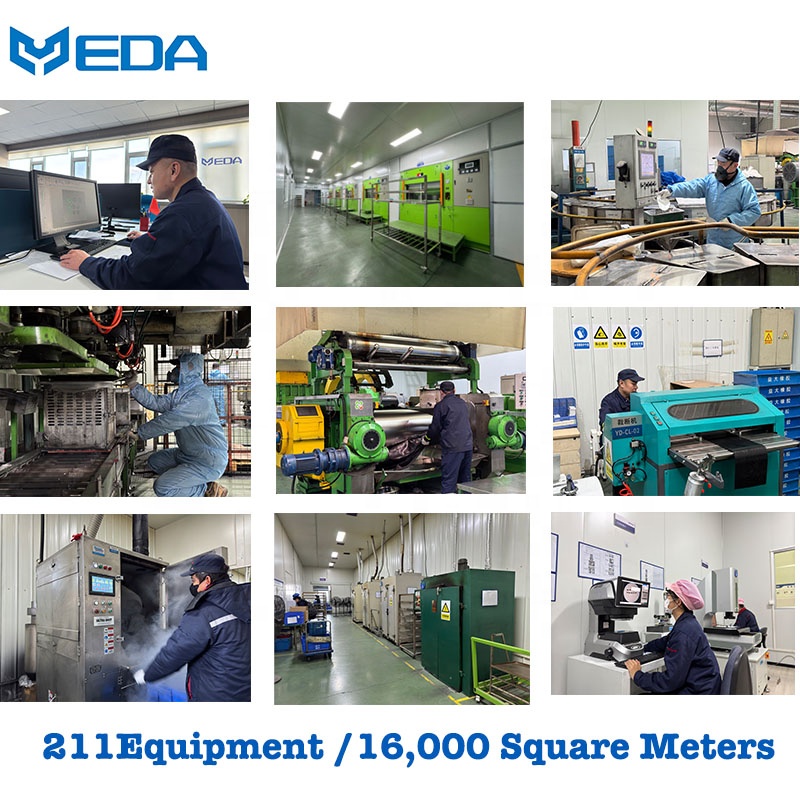
Dalian Yida Precision Rubber Products Co., Ltd. works with customers on O-rings, gaskets and custom molded rubber components for industrial applications. For hydraulic sealing applications, our review begins with the operating data rather than a generic material recommendation.
Customers can send a drawing or sample together with fluid, temperature, pressure, hardness and quantity requirements. Based on the information provided, Yida can discuss NBR, HNBR, FKM or EPDM options, prepare samples and confirm measurable requirements before mass production. Dimensional checks, hardness, appearance criteria and batch information can be agreed as part of the inspection plan.
The objective is not to promote the most expensive compound. It is to select a hydraulic seal material that matches the fluid and duty cycle, then reproduce the approved specification consistently. Send Yida the complete application conditions for a material review and quotation.