Why Are O-Rings Widely Used in Industrial Equipment, and How Do You Choose the Right One?
A Little Seal with a Huge Installed Base
There are many reasons for the popularity of orings, one of them being that, due to the fact that an elastomer is a substance that can be molded in different forms and at different levels of tension, it is possible to use a single circular one in many compact interfaces. The hardware has a groove and squeeze; system pressure can assist in energizing the seal. Standard sizes, wide-range compound availability, and simple installation have made industrial O-ring applications from prototypes to high-volume equipment inexpensive.
The standards are not stagnant and still develop. ISO has come out with ISO 3601-2:2025 for housing dimensions in general hydraulic and pneumatic service and SAE has listed AS568F as the 2026 revision of its inch-size standard. Updates do not mean that every standard-sized ring is also interchangeable; they serve only to emphasize that size, housing, and application must all be looked at together.
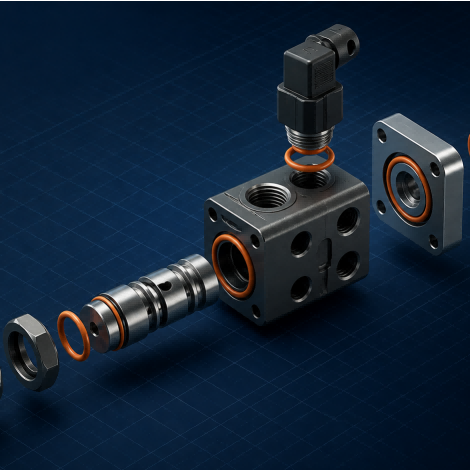
Why O-Rings Are Used So Widely
Common Industrial O-Ring Applications
Equipment area | Typical O-ring duty | Selection risk to resolve |
Hydraulic cylinders | Among industrial O-ring applications: static ports and reciprocating rod or piston seals. | Pressure, extrusion gap, speed, wear and fluid compatibility. |
Pneumatic equipment | Cylinder, valve, regulator and fitting interfaces. | Low friction, lubrication, rapid cycling and low-pressure sealing. |
Pumps and valves | Covers, plugs, cartridges, stems and process connections. | Chemical exposure, pressure pulses, temperature and assembly damage. |
Gearboxes and compressors | Housings, inspection plugs, shafts and oil or gas passages. | Oil compatibility, heat, vibration and dynamic use limits. |
Sensors and manifolds | Compact face, radial and threaded-port seals. | Small grooves, surface finish, cleanliness and tolerance stack-up. |
How an O-Ring Actually Creates a Seal
An O-rings groove compression is already a leak path closure in the absence of media pressure. Then, when media pressure reaches the O-rings' sides it drives O-rings to low pressure side, which causes O-rings to stretch and compress the media seal around them. An O-ring must always be given room to move freely and not be overfilled with gland.
Weakening the compressed volume leads in a leakage even at low pressure. On the contrary, when squeeze is excessively tightened there is an increase in assembly force and it makes the seals to wear out very soon besides it generates heat and friction. Excessive clearance can allow the rubber to be extruded through gap; sharp edges can cut it during assembly. Also, the finish and alignment of the components are of great importance because the O-ring will not do the job unless hardware provides a correct environment.
A Real Case: The O-Ring Was Only One Part of the Failure
As a direct result of the seal being blown in the aft field joint of the right SolidRocketMotor of the Challenger rocket, the RogersCommission blamed the accident on it. The primary O-ring failed to regain its round shape in the subzero temperature environment and, as such, had no physical means to seal the leak before hot gases started burning the material.
A rocket joint is not like a factory seal and this is not a Yida instance. A list of factors such as, the Commission pointed out: temperature sensitivity, the dimensions, the behavior of the material and the dynamic loading. The only thing to learn here is the fact of recovery rate of the seal, the joint movement and the entire pressure event may be responsible for one sealing and the other sealing.
How to pick the Right O-Ring: 8 Choices to make
1. Determine if the seal is static or dynamic
Even static seals must have the right squeeze and pressure support. Reciprocating action means more wear, lubrication, breakaway force and spiral failure. Continuous rotary usage might require a different seal.
2. Specify all the fluids and cleaning chemicals
Caption all types of fluid that flow during the process, grease, the agent used for washdown as well as the contaminants. Watch how much they have changed in quantity, hardness and surface condition. Sometimes, data of short contact might not be able to reflect the effects of a long exposure.
3. Refer to the actual temperature history
Keep track of the lowest, highest, and the normal temperatures, time periods at each temperature as well as temperature cycles. The cold one can slow the process of recovery while the heat one can make faster the compression set and aging. Published values of temperature just give a general idea but are not a permission.
4. Define pressure, vacuum, pulses and extrusion gap
Peak pressure and clearance have the effect on each other. High pressure may put rubber into a narrow area. A more rigid compound back-up ring could prevent it; yet, those change friction and size of the gland. Be sure that pressure in the sealing system is reversed.
5. Finish the sizing of O-ring and design of the groove
Diameter inside the ring and cross-section shall be chosen taking the groove's width, depth, stretch, squeeze, clearance and volume change into account,ISO 3601 and AS568 standards define O-ring dimensions and groove design; the finished drawing determines the seal.
6. Choose your material based on the family and the compound
O-Ring materials like NBR, FKM, EPDM, silicones, and even HNBR offer differing resistance from fuel and oil to water vapor, weathering, or mechanical stress at different temperatures. Polymer families can serve to narrow down but cannot grant final validation.
7. Ensure smooth surfaces and proper handling
Grind all ridges off, guard lead-ins and fix surface roughness. Twist, oversize stretching, dirt - these are major sources of damage. In cases where lubrication is necessary, use compatible lubricant and protect the ring as it passes through threads and ports.
8. Agree upon a standard of sealing performance
Make a leak limit, pressure and temperature conditions that the seal will be expected to meet, the number of cycles the application would be put in, the frequency of inspection and the definition of an end. This is how you will be able to decide which O-Ring is the right one by comparing evidence from the O-Ring assembly and not just by its compound name
O-Ring Material Selection is a Compound Decision
Picking the right O-ring material is a complex process that involves several factors like environmental conditions, failure mechanisms etc., narrowing down the compound to a few options and then analyzing the evidence behind those options. Additional requirements for material selection may arise from the area of application such as food-contact, potable-water, medical, oxygen or semiconductor. It would not be wise at all to take polymer family or color as the main reason for deciding on material.
What the Main Standards Prove - and What They Do Not
Reference | What it answers | What it does not prove |
ISO 3601-1:2012 | Defines inside diameters, cross-sections, tolerances and size codes. | Correct material, groove, pressure capability or leak performance. |
ISO 3601-2:2025 | Defines housing dimensions for general hydraulic and pneumatic uses, with or without back-up rings. | Suitability of a special application, surface condition or full duty cycle. |
ISO 3601-3:2005 | Classifies surface imperfections and gives quality acceptance limits. | Fluid compatibility, compression set or sealing in the customer's hardware. |
ISO 3601-5:2015 | Specifies selected widely used elastomer materials for industrial O-rings. | Every available compound or an automatic match to a specific fluid and temperature. |
ASTM D1414-22 | Provides procedures for O-ring physical properties and changes after aging. | Assembly leakage, groove correctness or field life under combined conditions. |
SAE AS568F is an inch size system. The dash number only identifies the dimensions and not the material. Specifications like material can be found in other documentations. The standards define O-ring dimensions, sealing groove details.
Verifying the O-ring in Final Equipment
In terms of seal material properties, aging effects, and changes, material testing methods are limited. They cannot catch an edge that is too sharp, a burr, a seal that is oversized, extrusion gap, incorrect squeeze, or a twist during assembly. The validation should therefore consist of complete production O Rings and hardware samples.
The following checks will assure that the drawings, hardware mating to the O-ring, groove, compound, O-ring size, and supply changes are fixed.
Incoming measurements should be confirmed as well as surface qualities, material certificates (if applicable) and batch numbers.
Inspect hardware features such as lead-in chamfer(s), sealing edges, etc., and assembly tool condition prior to insertion.
Condition the complete O-rings using actual fluid and temperature sequence, not just test slabs.
Use the production lubricant for assembly; apply stretch, twist, and control during installation.
Perform pressure test, vacuum, motion, and thermal cycling on typical hardware while recording leakage rates.
Inspect O Rings for damages such as nibbling, spiral, flattening, swelling, cracking, or wear and approve them written limits.
A Buyer-Ready O-Ring RFQ Checklist
Information to provide | Decision-ready detail |
Seal location | Face, radial, rod, piston, threaded port or another interface; static or dynamic. |
Media | Fluid name, concentration, contamination, cleaning chemicals and exposure time. |
Temperature | Normal, minimum and maximum values, dwell time and thermal cycling. |
Pressure and motion | Normal and peak pressure, vacuum, pulses, speed, stroke, frequency and direction. |
Hardware | Bore or shaft, groove dimensions, extrusion gap, surface finish, tolerances and material. |
O-ring requirement | Size system, cross-section, compound, hardness, color, approvals and surface-quality class. |
Validation | Leak limit, conditioning, cycle count, sample size, inspection and change-control documents. |
In case of an out of stock part, if a field part is suspected of causing a failure, try sending the used ring and the mating hardware (if available). From a flattened, cut ring or a swollen ring we cannot really get a clear indication except if we also know the position where the ring had been and the service history.
O-Ring Program Development with Yida
For customization in rubber seals (O-rings), please provide a set of detailed information like drawings or dimensions of pieces of hardware, list of fluids used, history of temperature and pressure, dynamic conditions, type of required documentation or certificates and what the demand would be per year along with what is the plan validation method. This way the focus of the O-ring discussion can revolve around material selection for the O-ring, control of dimensions and documentation of part properties instead of a general recommendation of a material.
In fact the solution on how to select the correct O-ring is simply to understand the whole application, select the size and compound of seal together, take care of the seal during assembly and test its performance on the leakage using a model part to release.