The Growing Role of Rubber Components in Industrial Robotics
Why gripping sealing cable protection and vibration control increasingly depend on application specific elastomer parts
For the first time, the number of robots in operation has exceeded five million worldwide and the number of newly manufactured robots has reached a high of just over 600,000 units in a report from the International Federation of Robotics. More machines of this type also mean a greater quantity of joints that must be isolated, vacuum interfaces, flexible connections, and end effectors subjected to repeated motion.
Elastomers used in robots have a relatively low profile but yet their contribution is substantial to the manner of grasping by the robots, the extent by which the machines prevent contaminants from getting to the joint as well as how the robots reduce vibrations on the tool. Their real worth is in the fact that they can be designed and used in such a way that they are compatible with a certain motion and conditions rather than rubber in general.
Only part of application is a robot arm
Roughly speaking at least, robot will follow a fixed path very precisely during execution, but still some variations in the process might remain which may affect the robot and the surrounding devices as well. For instance, over time, a suction cup can be worn out; one side of a bellows can be rubbing, causing friction; a cable grommet can move a bit and be in a loosened state, or a compliant pad will behave differently as the temperature is constantly changing. The position and condition of the workpiece are affected by those small interfaces.
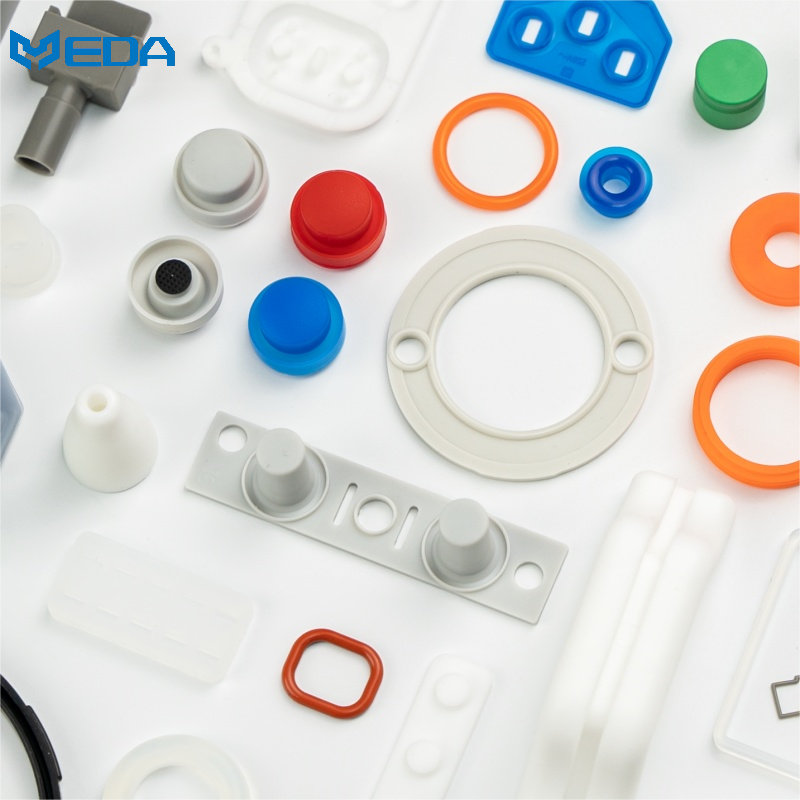
Custom rubberrobot parts are often found in grips, suction cups systems, tool changing mechanisms,电缆 routing devices, protectors shields, bump stops and mounting interfaces.
In some cases they even contact the product. Others help keep the robot dust and moisture free by sealing against dust, coolant or cleaning agents. Every part has different material and geometric constraints based on its specific position.
Gripping Depends on the Workpiece Surface
Rubber suction cups need enough compliance to conform to the workpiece while keeping a stable sealing edge. Smooth glass, porous board, oily sheet metal and a flexible food pouch cannot be handled with the same assumptions. Cup diameter, lip shape, bellows and vacuum level all influence holding force.
Fast acceleration can tilt or peel a cup even when static lifting force appears adequate. The end effector should be checked at the intended acceleration, robot orientation and emergency stop. Surface contamination and product variation also need to be included.
A Schmalz case describes a robotic cell that moves semiconductor components with 176 small NBR-ESD suction cups. The system was designed to place up to 31,000 chips per hour. The cup material, six-millimeter size and limited axial movement were selected for sensitive parts and precise placement.
That public case is useful because it connects the elastomer to a defined task. It is not a Yida result and does not establish a universal cup design. Another component, surface or cycle rate would require its own gripping and contamination review.
Seals Must Follow Repeated Motion
Robotic sealing components may protect rotating joints, linear actuators, pneumatic circuits or tool interfaces. A static enclosure seal has a different job from a dynamic wiper or flexible boot. Stroke, angular movement, speed and pressure should be stated rather than grouped under a general sealing requirement.
ABB describes foundry robots protected against coolant, dust, metal particles and cleaning agents. Its published Foundry Prime information refers to coated surfaces, protected electronics and polymer seals as part of a complete robot protection system. The enclosure rating belongs to the assembled robot, not one seal.
Robotic sealing components can support an ingress target, but mounting compression, mating surfaces and cable openings remain part of the result. A seal tested flat on a bench does not reproduce joint movement or cleaning spray on the installed robot.
Vibration Can Be at Several Interfaces
Robot vibration isolation is sometimes required at the base, between the wrist and tool, or inside a fragile end effector. The selection of the appropriate location depends on the intended protection: the floor, tool chatter or sensor shock.
Increased compliance can also be used to lessen positioning stiffness. A soft pad could provide a shock absorbing surface but may cause the tool to lag or oscillate. Engineers must specify maximum allowable displacement and setting time, after which complete motion profile should be tested instead of just hardness.
Cable and Hose Protection Must Be a Motion Map
Flexible grommets, strain-relief components and bellows are used to protect the cables and pneumatic lines when the robot changes its posture. The major strain may happen when the robot is at a corner of its workspace rather than in its home position. Torsion and bending are different because they result in different strain patterns.
Robot rubber parts can be specially designed with features like a lip, flange or strain-relief that eliminate the need for separate hardwares. Though the assembly may get easier through integration, the cable life will come to depend on the molded dimensions and material stiffness of the feature. The route and tension involved in assembly shall be checked.
Material Choice Follows the Cell Environment
The materials that you choose depend heavily of the operating environment of the cell. For instance, while NBR is suitable for oil exposure, EPDM is a great option for environments involving water and certain kinds of cleaning agents. In contrast, FKM is a likely material selection if the application is exposed to very high levels of heat or chemical-aggressive fluids. A silicone material is going to offer you temperature flexibility whereas a polyurethane one would provide abrasion resistance. However, whether a given material and its formula are suitable for the operation would be determined by the actual cell chemicals involved.
Food grade, semiconductor, and paint cell industries will include requirements like cleanliness, conductivity, release characteristics, etc. Even a compound that is capable of mechanical wear might still cause problems such as particle emissions, marking products, or reactions to a process chemical. In some cases, color and surface finish can also be significant factors influencing the results of a machine vision system.
Standards Define the Robot but Not Every Rubber Part
Standard ISO 10218 deals with robotics and robot system safety. It mainly defines the different hazards and responsibilities, but it does not qualify a random suction cup, bellows or grommet for service life. Component validation is still dependant on the application.
Enclosure protection for road-vehicle electrical equipment is the topic of standard ISO 20653. On the other hand, IEC 60529 standard defines more generally the enclosure IP codes. Both standards are applicable for the respective tested configurations. Obviously, the assembled rating cannot be transferred to the loose rubber seal alone.
A Validation Process for a Completed Product
With respect to rubber suction cups, first make a check of the physical dimensions and overall appearance, then measure the holding capability on various typical surfaces. You should also consider leakage, speed of movement, orientation, frequency of the cycle and surface wear. A safe arrangement also includes methods for detecting vacuum loss and a contingency plan for if a part is dropped.
With the covers and seals, you can do a full-motion test of the robot while varying the robot with a range of temperatures and the possible degree of contamination. Look for such things as contact imprints, cracks, extraction and internal contaminants. Cleaners used in such tests should be applied at the actual concentration and with a spray direction and time of exposure the same as in normal usage, but the actual time is up to test specification.
Finding and measuring vibration in the tool, its displacement and its settling are essential in robot vibration isolation. In addition, you need to measure the vibration level at the supporting structure. Reassess these checks once cycling and aging are carried out. The criteria determining the acceptance of the product should not only refer to properties of the material but also be linked to process accuracy.
Inputs Necessary Before Initiating the Development
You need to provide the robot type and specifications, payload, velocity, acceleration, motion path, space for mounting. You should also supply the information regarding the surface of the part which undergoes the cleaning, vacuum pressure level, media, cleaning procedure, ambient temperature, expected number of cycles and ESD or cleanliness requirement if any.
Dalian Yida Precision Rubber Products Co., Ltd. specializes in producing customer-specific custom-designed rubber parts by means of molding. When it comes to rubber parts for industrial robots, apart from Yida doing manufacturability checking, compound alternatives, key dimensional analysis and suggesting a plan for inspecting finished components, there remains responsibility of robot integrator for system safety and performance.
The robot market increase means that more sites require a flexible interface able to deliver reliable performance. Only then this interface becomes a valuable component of the automation system that by matching the rubber geometry with actual movement, surface and environment.