Custom Rubber Machine Feet for Industrial Equipment Stability
How load distribution stiffness floor conditions and installation details influence a stable machine support
A machine foot carries more than static weight. It also reacts to motor imbalance, reciprocating motion, tool impact and forces created when an operator loads the equipment. If the support is too soft, the machine can move. If it is too stiff, vibration may pass directly into the floor and nearby structures.
Custom rubber machine feet are useful when a standard catalog mount cannot match the load, bolt pattern, available height or exposure conditions. The design must begin with the machine and floor as one system. Rubber shape and hardness are only two parts of that calculation.
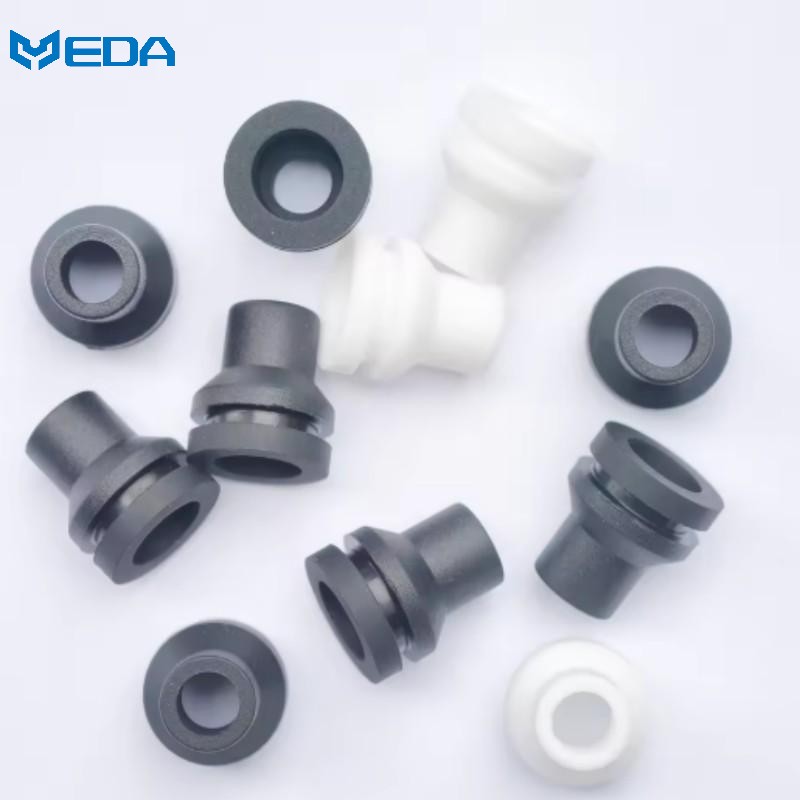
Consider Each Support Point
It is not a good idea to just split the total weight of the machine by the number of feet. Some components like motors, electrical cabinets or tooling are not only relatively heavy but are also more likely to change position over time and so change the center of gravity. Moreover, when running the machine at varying loads or speeds, it's also quite possible that one corner gets more force than others.
What is really helpful to know and decide about are just the lowest and highest load levels per mounting points. Each rubber foot has to be under a load level that does not take the system out of its stable operation mode, i.e. a point of the load-deflection curve that has been already controlled or tested (probably, the linear part). Inadequate load may not even allow the foot to seat well, yet overloading can quickly lead one part of the system to failure by running it out of clearance or even breaking it.
Stability and rigidity of industrial machines, in general, are very much affected by how well they are mounted through and at least to what extent they are grounded on the surface. A narrow setup of the support feet will allow the machine to rock (oscillate slightly from side to side) even when all feet are fully loaded. In that respect, it is advised that a designer should examine the machine height, support spacing and the direction of the dominant operating forces before finally choosing the rubber dimensions.
Leveling and Isolation Serve Different Purposes
Rubber leveling feet feature the combination of a metal adjusting part and a soft base made of a rubber-like material. An adjuster, in addition, levels out the ground and helps balance loads. The main role of the rubber is to enhance grip and some degree also to dampen the vibration, however the amount that the rubber is able to isolate is mainly due to the material and load it gets as well as the frequency of excitation.
The efficiency of anti vibration machine mounts is greatly dependent on the fact that their natural frequency is far below the forcing frequency of the vibrating machinery. It is a common mistake to use machine mounts solely based on the maxiumum load and not considering the level of vibration that the mount may not only support but also allow to pass. Besides normal operation, particular attention should be paid to startup, shutdown and variable-speed operation of the machine.
Just because it is a soft mount does not make it inherently better. It is a well known fact that excessive deformation in mountings can result in disturbances in alignment, pipe connections, guarding and precision-related procedures. In case the machine has an unbalanced or off-center load, it is necessary to use the mount sizes or stiffnesses differentially at each corner of the machine in order to maintain the operating position well under control.
Floor Conditions Change the Outcome
Trelleborg offers level mounts for free-standing workshop machines, that rely on an oil- and chemical-resistant rubber base to hold the machine without fixing it to the floor. That product example only demonstrates one of many design alternatives. It surely, however, does not mean that all unanchored machines are safe or stable.
Requirements for machine fixing depend on the equipment, location, and safety evaluation. Rubber supports can serve as position and isolation elements but should never be seen as anchors where the possibility of overturning, seismic loads, impact or connected services are factors which require fixed restraint.
How the Concrete Mixer Was Anchored in Public
A Trelleborg case story was about the Carmix One self-loading concrete mixer 4x4 . The four mountings resiliently supported the three-cylinder Perkins turbo-diesel engine. The supplier said that the mountings reduced the vibration level and protected the machine from harsh working conditions.
Cases can also show up why the source of vibration is important, engine order is the main factor, and then, speed, and occasional shocks and vehicle movements are taken into account to determine which types of mounts are best. The published results refer to that machine and that mount setup, they do not represent an assertion for a 'better foot.
Material and Hardware Must Be Reviewed in Conjunction with Each Other
Mineral oil-resistant NBR (nitrile butadiene rubber) is one type of rubber material that is suitable for machine components exposed to, e.g. mineral oils while the other (EPDM) that does not react much to water can, e.g., be used for areas of water exposure and some other situations as cleaning agents. Natural rubber usually offers good flexibility and is therefore favorable for isolating machines from vibrations from external sources. However, the families mentioned above have each of their own limitations, and the actual compound determines the characteristics like hardness, damping, aging and behavior at low-temperature. metal inserts and studs are another cause of failures. bond preparation, insert geometry, corrosion protection and rubber coverage influence durability. high bond-strength laboratory specimen results do not confirm that a stud will remain intact upon bending, prying or under repeated overloads at the foot in a real machine.
Leveling rubber feet should also have enough thread engagement left after leveling for the adjustment. a long exposed stud increases bending leverage. the use of locking hardware, the size of the wrench required to access various parts and the order in which the machine is brought down onto the feet have to be established as far in advance as practically possible.
What Common Tests Can and Cannot Show
ASTM D575 measures rubber properties in compression under defined conditions. It can compare compounds and provide load-deflection data, but a standard specimen does not include the molded profile, bonded insert, floor contact or dynamic forces of a complete machine foot.
ASTM D395 evaluates compression set. The result helps compare the tendency of materials to retain deformation after a specified compression and recovery period. It does not directly predict installed height after years of mixed static load, vibration, oil exposure and temperature cycling.
ISO 10846 describes laboratory measurement of vibro-acoustic transfer properties for resilient elements. Its methods support technical comparison, but installation conditions and machine structure still determine the response of the finished equipment.
A Practical Finished Part Validation
Begin with dimensional inspection and material identification. Measure the foot height, base diameter, stud position and critical rubber thickness. Check insert exposure, bond condition, flash and surface defects that could interfere with seating.
Apply the expected static load and record deflection at each support. Add a justified overload or proof load, then inspect for bond movement, cracking and permanent height change. Where sliding is a risk, test the base on the actual floor finish with representative contamination controls.
Run the equipment across its full speed and operating range. Measure movement or vibration at the machine and floor rather than judging by touch. Include startup, shutdown and abnormal but credible workpiece loads. Recheck alignment and connected pipes or cables after the test.
For anti vibration machine mounts, fatigue testing should use a representative preload, displacement and frequency. After cycling, repeat the load-deflection and bond inspections. Acceptance limits should be agreed before samples are approved.
Information Needed for a Custom Design
Provide the machine mass, center of gravity, number and location of supports, operating speed range and any impact or reciprocating force. Add the floor material, available mounting height, bolt details, leveling range and whether anchoring is permitted.
List oils, coolants, cleaning chemicals, outdoor exposure and temperature limits. Define acceptable movement, deflection and transmitted vibration. These inputs make industrial equipment stability a measurable requirement rather than a broad expectation.
Working With Yida
Dalian Yida Precision Rubber Products Co., Ltd. develops custom molded rubber components for customer-defined equipment. For industrial rubber feet, our review can cover molded geometry, compound options, insert design, critical dimensions and a sample validation plan.
We recommend evaluating custom rubber machine feet in representative hardware before mass production. When the load map, floor condition and operating forces are known, Yida can support a practical design discussion without treating a material data sheet as proof of machine performance.