How to Buy PTFE Gaskets: 7 Checks Before You Order | Yida
Content prepared by sunyihan
Dalian Yida Precision Rubber Products Co., Ltd.
Before requesting prices for PTFE gaskets, decide whether the material has already been selected. If it has, give every supplier the same grade reference. If it has not, send the flange drawing and operating conditions and ask for a recommendation. Compare the proposed materials along with the prices.
1. Material Type and Exact Grade
Virgin PTFE, filled PTFE and expanded PTFE are separate material options. A PTFE envelope gasket needs its core specified too. Their response to sustained loading differs; Dobson’s technical guide discusses the differences.
The order should carry the manufacturer and grade reference. With filled PTFE, record the filler. With expanded PTFE, get the actual sheet or product reference rather than stopping at “ePTFE”. Keep the matching data sheet with the approved specification.
A supplier can quote an alternative on a separate line, with its grade and data sheet attached. Have that change approved before it is substituted on the order.
2. Working Fluid and Chemical Compatibility
Give the chemical name, concentration and relevant additives. “Acid service” still leaves too much open. A cleaning liquid may also reach the gasket even though it is absent from the normal process description.
Compatibility needs to cover the complete grade. A statement for virgin PTFE should not be carried across to a different filler or envelope core without review. Send the exposure temperature and cleaning sequence with the fluid details so that the supplier can assess the actual combination.
3. Temperature and Pressure Together
Record the normal operating point first, then describe startup, shutdown, vacuum and any short excursions. A brief hot cleaning stage and a full shift at the same temperature are different duties; the quotation should make clear which one applies.
A catalogue may show maximum pressure and temperature on separate lines. Those limits are not necessarily available together. Garlock’s technical manual treats pressure and temperature together and qualifies ratings by the gasket and joint conditions. Request the recommendation for your grade, thickness and operating point.
4. Dimensions, Thickness and Tolerances
Use a released drawing for the inside and outside diameters, gasket thickness, bolt holes and their positions. Include tolerances and a revision. If “2 mm” appears on the drawing, make clear whether it means supplied thickness or a requirement after compression.
For an existing flange, do not increase gasket thickness simply because the old joint leaked. The FSA/ESA handbook recommends the thinnest suitable soft gasket that can accommodate the flange condition; thicker material can change load retention and pressure-temperature capability. The flange surfaces and available bolt load still need assessment. FSA/ESA Gasket Handbook.
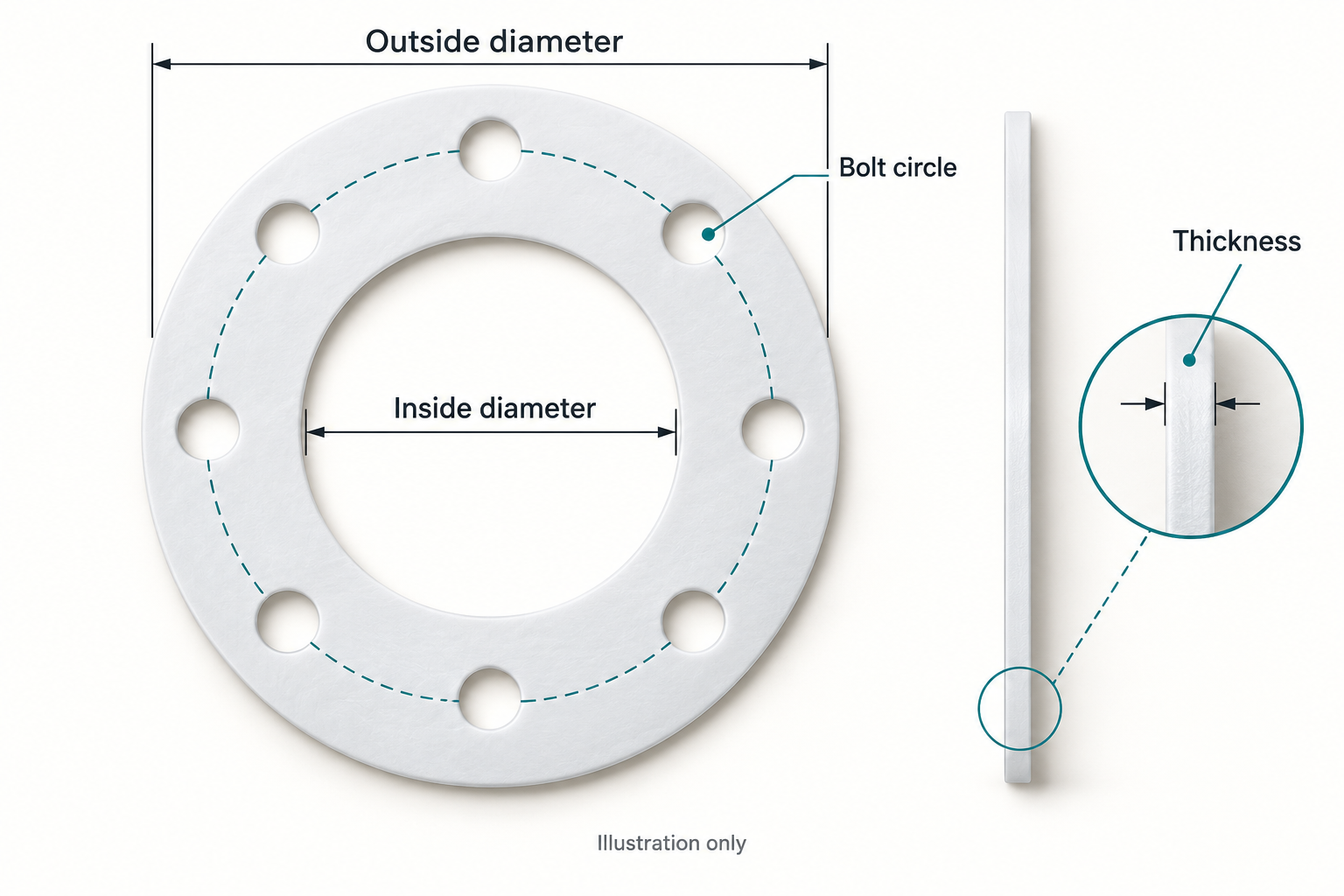
Generic dimensional illustration, not a production drawing. Actual hole patterns and dimensions depend on the flange and approved specification.
5. Flange Type and Dimensional Standard
For flange gaskets, a drawing saves a round of clarification. DN50 gives a nominal size, but the supplier still needs the gasket outline: a ring inside the bolt circle, or a full-face gasket with bolt holes. Include the flange material, facing and pressure designation. Use an approved drawing for a nonstandard joint.
Put the dimensional standard and edition on the order. ASME B16.21:2021 covers nonmetallic flat pipe-flange gaskets. For PN-designated systems, EN 1514-1:2024 covers flat nonmetallic gaskets within its scope; PTFE envelope gaskets have a separate reference, EN 1514-3.
Matching the flange dimensions is one part of approval. The PTFE grade must also be assessed against the fluid, pressure, temperature and assembly conditions. A dimensional standard does not certify the installed joint as leak-free.
6. Compression, Load Retention and Leakage
A gasket can seal when it is fitted, then lose contact pressure as the material creeps. Before accepting a grade, ask for its seating requirements and load-retention data at the thickness you plan to buy.
In a published VSP Technologies case, PTFE-lined chemical piping leaked at ambient temperature. VSP reported gasket creep and liner relaxation as contributing factors and selected a spring-inserted gasket to help maintain contact stress. Even without high temperatures, this joint had a load-retention problem.
With ASTM F38-18(2024) results, read the conditions beside the number: method, applied stress, temperature, duration and specimen. F38 compares creep relaxation under controlled conditions and calls for correlation with field results. The acceptance limit for your flange still needs to be agreed.
For a critical joint, include a sample trial before production approval. Confirm the grade and dimensions, assemble to the joint designer’s loading requirements and procedure, then measure leakage through representative operating cycles. Set the leak limit beforehand. Afterwards, inspect the gasket and flange faces.
7. Material and Quality Documents
A material data sheet will not tell your receiving team whether the delivered gaskets meet the specified dimensions. For that, request an inspection report tied to the order and drawing revision.
Agree the paperwork with the quotation. Record the approved grade, required batch identification and test documents on the order. If the supplier proposes a material substitution, get the change in writing and approve it before manufacture.
For test reports, look for the grade, thickness, specimen, conditions and date. Food-contact or other compliance documents also need review against the destination market and intended use. A general statement that the gasket is made from PTFE leaves those questions unanswered.
A Short RFQ Example
The following is an illustrative enquiry, not a customer record or a validated material recommendation. It shows what to add to the brief request at the beginning; the example values are not approved operating limits.
| RFQ field | Example information |
|---|---|
| Grade | Virgin PTFE proposed; supplier to confirm suitability and identify the grade. Alternatives need approval. |
| Geometry | Drawing PG-102 Rev B, including diameters, hole pattern and tolerances; nominal thickness 2.0 mm. |
| Flange | EN 1092-1, DN50 PN16; facing and gasket form identified on the drawing. |
| Service | Process water; normal 60°C and 6 bar; maximum 80°C and 10 bar; startup minimum 10°C. Confirm whether the maxima coincide. |
| Approval | Grade data, dimensional report and proposed joint-validation plan for customer review before release. |
| Order details | 100 initial pieces, estimated annual demand 5,000; required date and protective packaging to be agreed. |
Yida supplies virgin PTFE, filled PTFE and expanded PTFE gaskets. For a quotation, send the drawing and service conditions together with the order quantity, annual demand and required documents. The specific grade, dimensional requirements and any project tests should be confirmed before production approval. Send your gasket enquiry to Yida.