High-Performance Elastomers Are Driving the Shift Toward Advanced Sealing Solutions
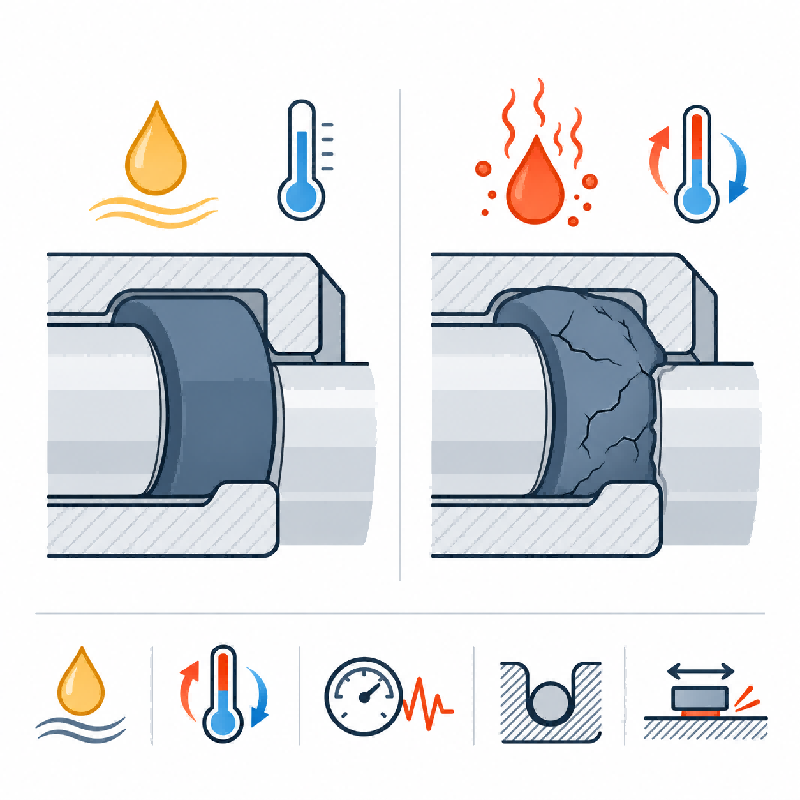
A seal operating with warm hydraulic oil might not survive the same temperature but a different liquid. Alternatively, a seal might withstand the chemical process but fail due to repeated heating and cooling, losing a physical connection. Thus material selection requires deeper inspection compared to a known polymer.
In environments with tough operating conditions, HNBR, FKM and FFKM present good choices.
Modified PTFE as well should be taken into account even though it is technically a synthetic polymer not an elastomer. The recent supplier product catalog show such a trend towards specialization.
Trelleborg’s semiconductor sealing range for example features application specific FFKM materials rather than just single material to tackle all processes.
This would be a rather honest depiction of technological evolution over a sweeping pronouncement saying that all seals are now “higherperformance.”
High-performance sealing materials from Trelleborg semiconductor sealing
For a buyer, high-performance sealing materials have to solve a definite operational problem. A more expensive compound is not necessarily a better seal.
In a meeting with Dalian Yida Precision Rubber Products Co., Ltd. about project details, all the following should be considered: the fluid, a sequence of temperatures,pressure and joint geometry. This is quite important to see that the modification suggested is addressing the real cause of failure.
Start with the reason the existing seal is struggling
Before changing material, inspect the removed component and review its operating history. Swelling, cracking, abrasion and permanent deformation suggest different questions.
A swollen seal calls for a fluid-compatibility review. A damaged sealing edge may instead point to installation, clearance or inadequate support. Changing the polymer without examining the joint can leave the original problem unresolved.
Temperature needs similar care. Record normal operation, short peaks, shutdown conditions and cold starts. A maximum-temperature figure does not describe the full duty.
Pressure also has more than one value. Pulsation, vacuum, reversal and decompression may matter as much as the steady operating pressure.
The useful specification combines these exposures. A material may perform well in separate heat and immersion tests yet still require validation under the intended sequence.
HNBR is useful where mechanical duty remains important
HNBR is produced by hydrogenating nitrile rubber. It provides an option for applications requiring oil resistance together with improved resistance to heat and environmental aging compared with conventional nitrile formulations.
Parker’s published HNBR information describes compounds developed for energy applications and identifies abrasion resistance as one reason for their use in drill-bit bearing seals. These are compound-specific applications, not approval of every HNBR grade for every oilfield environment. Parker HNBR sealing compounds
HNBR seals can therefore deserve consideration where mechanical damage, oil exposure and temperature occur together. The fluid composition and low-temperature requirements still need checking.
They should not be treated as a universal replacement for NBR. If the existing compound already meets the duty reliably, an upgrade needs a practical justification.
For dynamic applications, review friction, wear and the condition of the mating surface. A stronger material does not remove damage caused by an unsuitable edge or contaminated sliding interface.
FKM and FFKM are related options with different economics
FKM is widely considered for demanding heat and fluid exposure, but its suitability depends on the formulation and the chemical involved. Trelleborg’s technical guidance notes that FKM chemical resistance is influenced by fluorine content. A family-level compatibility label is therefore only a screening tool. Trelleborg chemical compatibility guidance
FFKM provides further options for severe chemical and thermal duties. It is not immune to every process, however, and different grades can target different exposure conditions.
Comparing FKM and FFKM seals should include the consequence of failure.
If you have access to the utility connection, the replacement probably won't be a big problem. However, the cost of production equipment may consist of the cost of downtime and cost of contamination in a production process.
Frankly speaking, that doesn't mean FFKM is the right choice always. A process of justification and evaluation must come after deciding to employ FFKM. Moreover, the selected FFKM grade needs the proper groove and assembly for it to operate satisfactorily.
The table serves merely as a guide, you will not find an accurate ranking. Because different sealing situations are affected by countless factors, it would have been a miracle to find a single sequence “from normal to best” that could fit all scenarios.
Modified PTFE changes the design dialogue
Polytetrafluoroethylene(PTFE) has a different property than rubber, which means it can be stretched or compressed to different degrees and won't come back to normal if overstretched in one go.
If you apply heavy loads over time to a PTFE item, it will deform permanently.
According to Parker’s PTFE seal design guide, creep is one of the main considerations in design. In view of the peculiarities of PTFE material behavior, the overall sealing system should be designed accordingly rather than assuming that PTFE is a direct equivalent of rubber.
Parker PTFE seal design guide
Depending on the design, modified PTFE seals can utilize spring or elastomeric energizer. With this, the supporting components then become part of the material-compatibility assessment.
What “modified” means? it can refer either to a polymer modification which is different from the virgin PTFE, while filled PTFE changes particular properties by adding materials the actual grade designation of the supplier is critical.
A successful seal using Modified PTFE must include a whole arrangement to be considered: sealing lip, support, clearances, mating surface and of course energizer. No matter how good the specifications of a polymer can be a single sheet will not do the qualification of that assembly.
A public semiconductor example of Trelleborg reveals that specialized formulation adds value
Isolast PureFab product line of Trelleborg features multiple customized FFKM formulations designed for semiconductor sealing. It provides open-source details which connect material development to process compatibility, purity, and sealing-force retention.
As an open example of material development that is not related to a Yida customer result, it reflects that stringent requirements might result in a formulation change even within the same polymer family.
Trelleborg Isolast PureFab should be noted that the list does not imply that each formulation is compatible with each plasma, chemistery-process, and sequence of temperatures. The conditions (e.g., tool), as well as the grade used still must be properly matched.
It brings one point to the table that advanced sealing solutions are evidence based and targeted.
Material tests narrow the choice but do not approve the joint
ASTM D471 evaluates the effects of liquids on rubber under defined test conditions. It can support comparison of changes caused by exposure. It does not establish the pressure capability or service life of the finished seal. ASTM D471
An immersion result should identify the fluid, temperature, duration and specimen condition. Without those details, two reports may not be meaningfully comparable.
HNBR seals and other elastomer candidates should then move from material screening to representative component testing. Check fit, assembly damage and leakage after relevant conditioning.
For FKM and FFKM seals, include the proposed production condition. A result from a different formulation or processing history should not automatically transfer to the supplied part.
A practical approval sequence is:
Application review → compound shortlist → relevant exposure tests → molded or machined samples → controlled assembly → operating tests → post-test inspection → production approval.
Ask for a justified choice rather than the highest grade
An inquiry should include the drawing, contact media, temperature sequence, pressure conditions and expected maintenance interval. Where a seal has failed, photographs and removed samples can be useful.
For a project discussed with Yida, agree the required evidence and finished-part acceptance criteria before selecting a material solely by reputation.
High-performance sealing materials become valuable when they address a real limitation without creating another one. A chemically resistant compound that assembles poorly is not a complete improvement.
Advanced sealing solutions may involve a better compound, a different profile or a supported sealing arrangement. The right decision connects the material with the joint and demonstrates performance under the intended duty.