Where Do the Mechanical Advantages of Rubber Gaskets Make a Difference?
Rubber gaskets work via deformation. If compressed between joining surfaces, then they will not only make a tight contact but also adjust to any small roughness of a surface. The success of the material is the fact that it can deform, but it can also remain in that state, i. e., not return rigidly to the original shape.
Once installed, the problem is ensuring that the contact is still sufficient. The gasket behavior may be influenced by a variety of factors - temperature changes or fluid exposure, or simply sitting still in a compressed state for a long time. A sealing component that worked fine when it was assembled might not seal anymore due to long usage.
The properties of a rubber gasket must hence be analyzed collectively. Hardness, tensile strength and recovery are separate parameters, but when taken together they can give an idea of the overall seal performance. No one single value can tell for sure that the gasket will not leak.
For instance, ASTM’s compression-set test, D395-18(2025), is just one example of this sort of distinction. The method simulates the state of a compressed rubber after a certain time, especially that resulting from static loading conditions. It is just a material evaluation test, which does neither a joint assemble pressure rating nor a lifetime guarantee of the seal at service temperature. A gasket material tested according to D395 may have an acceptable compression set of say 10%, but this value is independent of the actual seal performance in the joint assembled with the material, as long as the design does not take the seal leakage path into consideration as a safety parameter. In short, the D395 compression set test is just that, a test method of material property, which is a separate aspect from the seal performance of an assembled system under the load that causes contact sealing pressure at that joint face, e.g., by an external tightening force.
The first advantage is making the joint in touch with each other
Machined surfaces cannot be perfectly smooth. Although a flange looks flat, little unevennesses continue to exist across the interface. Rubber will deform around these unevennesses and will help break a leakage path from happening.
This by no means is the gasket’s job alone that one can use it for the repair of any flange that is damaged. Deep scratches, excessive distortion or poor alignment can be beyond the capacity of the seal. The mating surfaces are still the part of the sealing system.
In addition to sealing, compression creates a force in the opposite direction that acts on the seal. That reaction force is helpful in keeping the seal in contact with the other parts that it separates. How many forces you need to achieve contact are dependent on what type of sealing compound you use, how thick it is, the type of profile and the degree of the containment.
The broad flat gaskets may need a different load from the one a narrow molded sealing bead made of the same rubber will require.Material is soft only to an extent and it alone cannot tell us how much the part will compact if it compresses.
In a case where there are plastic covers or insufficient clamping force, the gasket needs to provide a sufficient level of contact but also not ask for a level of compressive force that would distort the housing. This becomes important at an early stage in the design.
If you talk about a part to Dalian Yida Precision Rubber Products Co., Ltd., you have to also show them the mating surfaces and assembly arrangement in addition to the gasket drawing. These are information needed to actually start talking about what material to use, what design shapes are suitable, etc.,.
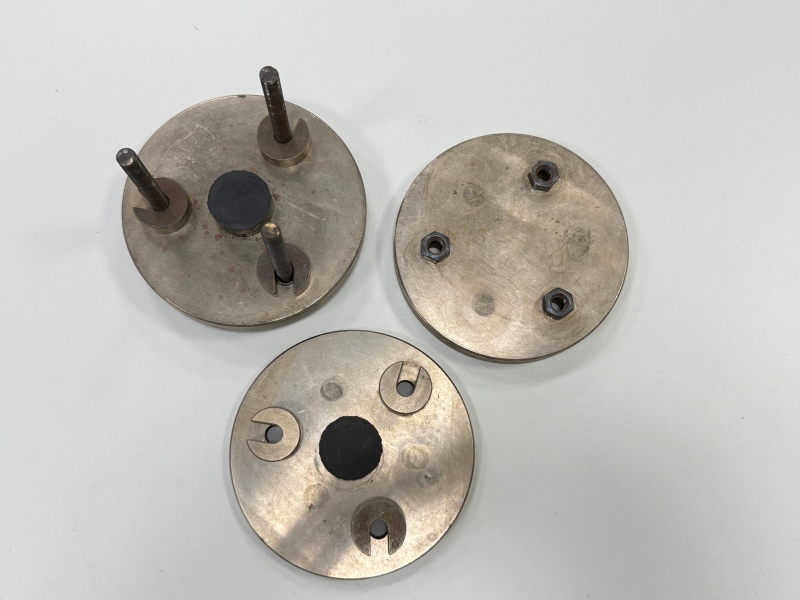
Figure: ASTM D395 compression set test fixture, a device employed in the assessment of rubber material recovery upon compression, with controlled setting. Note that this is just a material testing specimen, not a finished gasket that has been mounted.
Recovery matters after the load changes
When the rubber is allowed to be in a state of compression lessened by the load reduction, the rubber piece recovers it original shape. This helps the seal withstand even minor shifts in clearance of the joint caused by a variation in the temperature levels or movement.
However, rubber recovery does not have a ceiling. It can deform for good after getting compressed, especially when operating under very harsh temperature and environmental exposures.
Rubber gasket compression set measures the remaining deformation that happened through a specific testing process. If the conditions are basically the same, an even smaller numerical result could suggest a better level of recovery after unloading, that is after the test load is being released.
In order to be meaningful, the conditions of the experiments need to be similar. Factors like the testing procedure, temperature variation, time of exposure, geometry of the piece to be tested, recovery method, all play a role in determining how the result should be interpreted.
Material that gave a good performance in the lab should still be evaluated in the intended environment.
The key difference is that there are instances where one can recover from unloading while retaining the force when it is compressed.
The last question is about the phenomenon of stress relaxation.
A gasket, after being compressed for several weeks or months, might not have changed its shape or appearance and at the same time, the force which it exerts against the flange decreases. Therefore, one must realize compression set is not the only rubber property one should take into account. There are several sealing mechanisms that may be used in seals with rubber properties. For example, stress relaxation might be one of them.
The properties should be interpreted and understood in the light of the different questions
The most appropriate datasheet is the one from a material that fits an application and has appropriate values not the one of the highest ones only.
Property | Practical question it helps answer | Important limitation |
Hardness | How resistant is the rubber to local indentation? | Does not directly establish assembly force |
Compression response | What load is needed to deform the gasket? | Depends strongly on geometry and confinement |
Compression set | How much deformation remains after the specified test? | Does not directly measure retained sealing force |
Stress relaxation | How does force change while deformation is maintained? | Test conditions must represent the intended duty |
Tensile strength and elongation | How does the material behave when stretched toward failure? | Does not establish a pressure rating |
Tear resistance | How resistant is the material to tear growth under a defined test? | Does not eliminate damage from sharp edges |
Rubber gasket mechanical properties should therefore be selected according to the expected failure mode. A thin web that tears during installation raises a different question from a flange gasket that loses sealing force after prolonged heating.
For a static joint, compression behavior may deserve more attention than abrasion resistance. For a component exposed to repeated handling, damage resistance becomes more relevant.
The specification should reflect those differences rather than applying the same property targets to every gasket.
Strength helps during handling but does not define pressure capability
Tensile strength and elongation are useful when a gasket must stretch during installation or tolerate deformation around a complex profile.
A gasket with narrow bridges, bolt-hole features or thin edges may experience local strain as it is positioned. Handling can damage these areas before the equipment begins operating.
ASTM D412 covers tension testing of vulcanized rubber and thermoplastic elastomers. Its results describe material behavior under specified tensile-test conditions. They do not establish the maximum operating pressure of a finished gasket. ASTM D412
Pressure resistance also depends on the joint. Clearance gaps, support, compression and flange stiffness influence whether rubber remains contained or is forced into an opening.
Higher tensile strength cannot compensate automatically for an unsupported sealing edge. Likewise, high elongation does not mean that repeated stretching will be harmless.
Where installation damage is a concern, review edge radii, handling methods and the gasket profile as well as the compound.
Harder rubber is not automatically a better choice
A harder compound may help resist deformation in some supported designs. It may also require more assembly force or conform less readily where the available load is limited.
ASTM D2240 measures durometer hardness through indentation. It provides a useful material-control measurement, but it does not directly establish gasket stiffness, tear resistance or leak-tightness. ASTM D2240
Two gaskets with the same Shore A hardness can behave differently if their thickness, cross-section or compound formulation differs.
Rubber gasket material selection should therefore begin with the application, not a preferred hardness number. Consider the operating temperature, fluid exposure, available load and dimensional tolerances together.
A softer material may be appropriate for one housing joint and unsuitable for another. The objective is controlled sealing contact, not maximum softness or maximum hardness.
A published design example combines flexibility with support
Parker’s Integral Seal technology is a recorded instance of this type of solution. This particular design merges a molded rubber sealing element with a rigid carrier instead of depending on an unsupported rubber gasket only. Parker’s edge-bonded gasket design
According to Parker, controlled elastomer squeeze is one of the methods of achieving contact with the mating surfaces. Their published design parameters also consider pressure, temperature, media, vibration, and thermal expansion.
This is a case for a publicly available product design example, not a Yida customer case. It shows how the deformation of a gasket can be used in conjunction with a structural support.
In no way is it a proof that every bonded design will outperform every solid rubber gasket. Carrier stiffness, bond integrity, assembly load and application compatibility still need to be checked.
An important design takeaway is that the gasket seals well in the joint because of the interaction between the compound and the joint design. It may very well be that enhancing the material only will not solve a geometry issue.
Properties must remain acceptable to work environment
Room-temperature data is a foundation for further information, it tells little about the conditions that the gasket will be exposed to besides room temperature.
Heat can cause the change of recovery and also, force retention. Fluids may cause change in the shape and the properties of the material. Cold makes rubber stiff.
All the mentioned effects can change how much the gasket will be compressed. However, swallen gasket does not mean better joint seal: sweling can lead to increased distortion or rubber being pushed outside of the sealing area.
The selection of the rubber gasket material must be based on the entire exposure timeline. During service, the part can be at very different environmental conditions, such as production, cleaning, and restart phases.
Performing the testing after exposure to the corresponding environment can verify if the mechanical properties of the original material are still appropriate for the usage. In such cases, an alternating condition representative cycle could be the best choice when considering isolation of environmental exposure from other influences.
Test the assembled gasket against mating parts
Material tests are used mainly to filter out candidate compounds which are not suitable. Then, part testing is done to confirm that the chosen compound, along with the shape or the geometry, works as desired.
Start with dimensional inspection and then do controlled trial assembly. After that, assess the performance of the components under relevant pressure, temperature, and exposure conditions.
Validation stage | What to examine | Basis for acceptance |
Sample inspection | Thickness, critical dimensions and functional surfaces | Approved drawing and defect criteria |
Trial assembly | Fit, twisting, pinching and housing distortion | Defined mating parts and assembly method |
Compression assessment | Required load and installed gasket position | Agreed joint design requirements |
Exposure testing | Material and dimensional changes | Defined fluids, temperatures and durations |
Operating test | Leakage under representative conditions | Agreed pressure and leakage criteria |
Post-test inspection | Extrusion, cracking, tears and permanent deformation | Defined rejection criteria |
The validation sequence should connect application review, material screening, sample inspection, trial assembly, exposure testing and operating tests before production approval.
Gasket sealing performance must be evaluated against a defined acceptance limit. “No obvious leakage” may be insufficient where the application requires a measured leak rate.
Disassembly is also useful. A joint can pass a short pressure test while the gasket has already developed damage that affects later reliability.
For custom rubber gaskets, test samples should represent the intended compound, geometry and production condition. A laboratory specimen cannot reveal every molding or installation issue.
What to include in a custom gasket inquiry
Provide the gasket drawing and mating joint information, including surface condition, available compression space and assembly load where known.
State the pressure, temperature, contact media and operating sequence. Identify whether the gasket will remain installed or be removed repeatedly for maintenance.
For a project discussed with Yida, agree which material properties matter, which tests are required and how the finished component will be accepted. Specific evidence should support any claimed performance.
Custom rubber gaskets deliver their mechanical advantages when deformation, recovery and damage resistance are matched to the joint. The best choice is not simply the rubber with the highest strength or lowest hardness. It is the component that maintains the required contact throughout its intended duty.