The O-Ring Met the Specification. It Still Cracked: Lessons from NASA's 2005 Valve Investigation
The O-Ring Met the Specification. It Still Cracked: Lessons from NASA's 2005 Valve Investigation
What ozone exposure, local strain, installation geometry, and service history add to an O-ring purchase specification
A Leak Test Changed the Question
In April 2005, Space Shuttle Discovery was being prepared for return to flight when a helium signature test found leakage in the gaseous-hydrogen system. The source was traced to flow control valve LV-58 on main engine 3. Radioclastic fractures were limited to one region when investigators looked at the nitrile/Buna-N seal.
They found one odd fact—the ring was actually to the right thickness according to its specification. It was not a case where a piece of the rubber was mistakenly used or introduced. Instead, it was the NBR O-ring in a specified part that was documented being faulty, and now the important question was: what had the specification left out?
Practical takeaway: a material specification can define the compound and still leave the installed exposure path, local strain, aging clock, and replacement interval unresolved.
What NASA's Investigation Actually Found
NASA did not stop after replacing the leaking ring. The other two valves on Discovery were opened, followed by the corresponding valves on Atlantis and Endeavour. Six of the nine O-rings showed cracking. The LV-58 ring remained the worst of the group, but the wider inspection changed the problem from a one-off leak to a repeated condition.
Case checkpoint | Recorded finding | What it changed |
Pre-launch leak check | In 2005, Discovery failed a helium signature leak test. The leak was traced to flow control valve LV-58 on main engine 3. | The removed O-ring became the starting point for a fleet-wide material review. |
Inspection across three Orbiters | Six of nine valve O-rings had cracks. The LV-58 part was the most severe, with radial cracks that could cross the sealing surface. | A single leak was no longer treated as an isolated assembly event. |
Localized measurements | At the cracked quadrant, Shore A hardness was almost four points higher and storage modulus about 25% lower than the rest of the ring. | One average hardness reading would not have described the damaged area. |
Tensile and age review | Four out of the eight rings which were tested did not reach the 1,350 psi specification that has been set.Stored reference rings represent approximately 8 to 26 years of age. | Investigators compared condition, location, and age instead of relying on paperwork alone. |
Exposure path and control | A gap up to 0.009 inch exposed the ring's outside diameter to ozone, pressurized air, and elevated temperature. NASA adopted a three-year replacement interval. | The corrective action addressed time in service as well as material identity. |
Those numbers need a little restraint. The report does not prove that every old nitrile seal will crack, nor does it give a universal three-year life for NBR. It records what happened in one valve design and why NASA selected that control for the remaining Shuttle program. That boundary is important when the case is used outside aerospace.
The Specification Was Valid, but the Environment Was Different
According to the NASA assessment, the MIL-P-25732C nitrile material was intended for a hydraulic-fluid environment that would help protect it from cracking. In the valve, the O-ring was used in an air-only environment. A design gap as large as 0.009 inch left part of the outside diameter exposed to ozone, pressurized air, and elevated temperature.
That distinction is what the case revolves around. Determining if an o-ring material will work is more than a simple matter of checking its compatibility with the process fluid in question. If other conditions like, for example, the presence of oxygen and nitrogen on the back side, frequent dry operation, vapors from cleaning, lubricants use, and storage conditions are present then the o-ring’s material selection must also take these into account. A material chart is not sufficient for an exposure scenario that does not appear on the drawing or is not specified on an RFQ.
For a normal industrial project, the inference is straightforward: list every environment the rubber sees, then note which surface is exposed and whether it is stretched. Do not copy NASA's life limit. Copy the discipline of connecting material, geometry, environment, and time.
Why Ozone Cracking in Rubber Is Tested Under Strain
The current ISO 1431-1:2024 procedure evaluates vulcanized or thermoplastic rubber under static or dynamic tensile strain in air containing a defined ozone concentration. ASTM D1149 applies ozone exposure in a controlled way on strained samples and evaluates the degree and nature of surface cracks. Both systems include strain as part of the question, not background information.
Additionally, the ASTM cautions that results from accelerated testing might not match very well with real-time performance in the field. This caution, however, can easily slip out of one's mind or get swept under the rug. Laboratory comparative tests can classify materials in a given set of test parameters; they just do not have the capability to replicate precisely all of those factors of real-life situations like every indentation and crack, changes in temperature, periods of non-service, et al.
Hardness Was One Clue, Not the Whole Diagnosis
On the cracked quadrant of LV-58, the outside-diameter hardness was almost four Shore A points higher than elsewhere. Dynamic mechanical analysis showed storage modulus roughly 25% lower in that area. The same ring was not behaving uniformly around its circumference.
A receiving-inspection hardness result can still be useful, especially for lot comparison. What it cannot do is certify an installed seal's future condition by itself. Location matters. So do crack orientation, dimensions, tensile properties, leak behavior, and the surface that faced the exposure path. Good O-ring validation testing combines these observations instead of asking one number to carry the decision.
Shelf Life and Installed Life Are Different Clocks
ISO 2230:2026 covers inspection, records, packaging, and storage before rubber products are put into circulation. That is a useful control for stockroom condition and traceability. It does not turn a stored-part age into an installed service-life prediction.
After fitting the O-ring the clock changes.
Squeezing, stretching, temperature, atmosphere, fluid contact and downtime get started to work together. Therefore, a reasonable life of rubber seal should be based on two data: storage conditions before installation and the part history. Combining these data into a vague 'shelf life' field doesn't give a maintenance crew the exact information they are looking for.
A Six-Step Validation Path
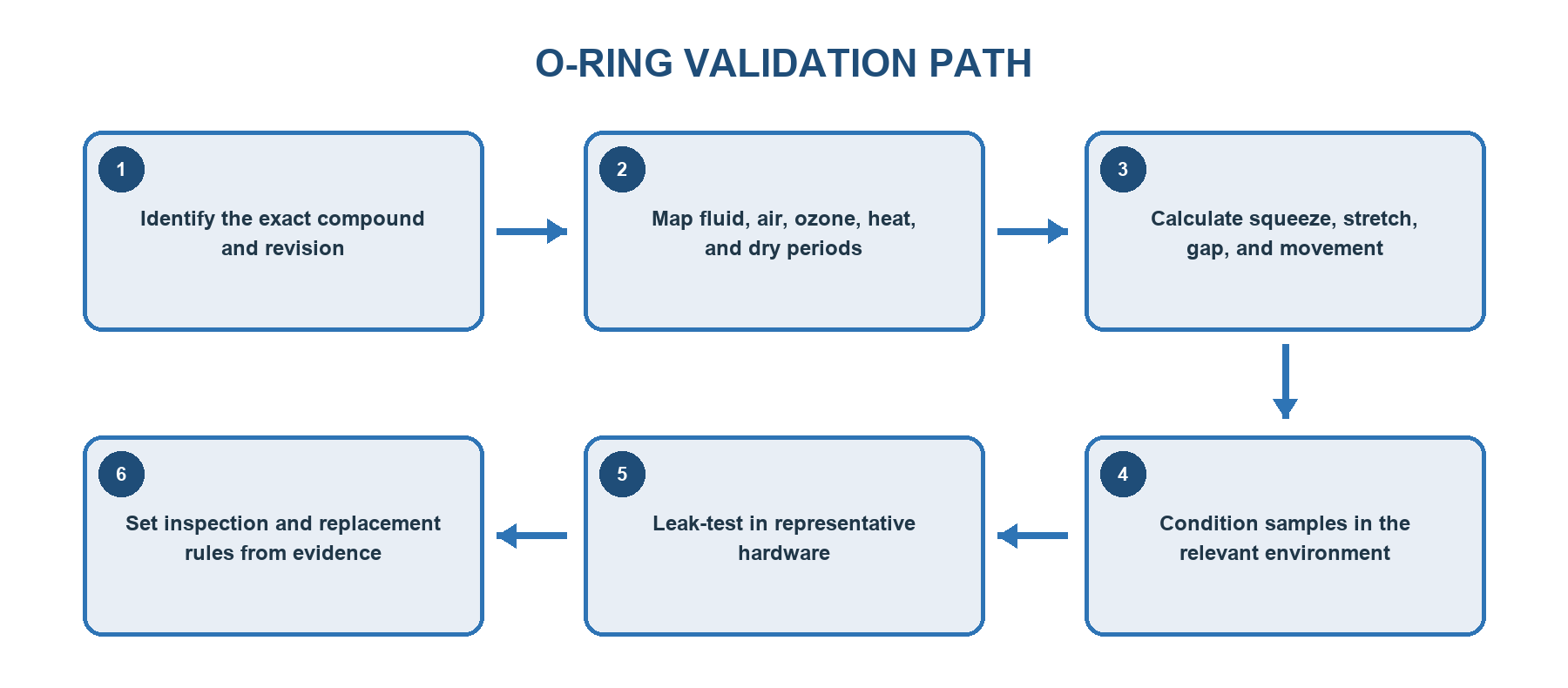
Validation is the process of aligning material specifications with its usage and servicing requirements once installed.
This entire sequence of steps has a particular application and hence it starts with the drafting and combination documents of the system, then the exposure path or route will be defined through which a physical component will be located inside a device. As an inspection or replacement rule, this last step just simply indicates that the design is not yet finalized and so, there is no permanent approval yet. It is tied to the tested setup with a field finding route that could change the rule.
Eight Questions to Put in the RFQ
Question to settle before sampling | A useful answer includes |
Which compound will actually be molded? | Polymer family, hardness, cure system, compound ID, revision, and any governing material specification. |
What touches each side of the seal? | Process fluid, lubricant, cleaning agents, surrounding air, ozone sources, and periods when the part is dry. |
Where is the rubber held in strain? | Installed stretch, squeeze, local bending, parting-line position, and any area left exposed by the gland. |
Can the hardware open an exposure path? | Maximum gap, tolerance stack, pressure direction, movement, venting, and the surface that faces the atmosphere. |
What is the real temperature history? | Storage, assembly, standby, operating peaks, dwell time, shutdown, and cycling - not one catalog temperature. |
How old is the part when service begins? | Mold date, packaging date, storage conditions, issue date, installation date, and traceable lot records. |
What test will decide approval? | Representative hardware, conditioned samples, leak limit, inspection method, cycle count, and written rejection criteria. |
When will the seal be inspected or replaced? | A defined interval, removal criteria, field feedback route, and a rule for reviewing unexpected cracks or leaks. |
The table is not a request for every possible laboratory test. It is a way to find the missing condition early. If the seal remains wet in one machine but sits dry beside an electric motor in another, the same compound name does not make the two duties identical. That is where O-ring material compatibility moves from a catalog choice to an engineering decision.
Before Sampling: What Yida Would Review
For a commercial seal project, Dalian Yida Precision Rubber Products Co., Ltd. would begin with the drawing, compound requirement, media list, temperature history, and expected maintenance interval. We start off with the drawing and composite record of the material to be sealed, then trace it along the exposure path until the representative hardware part is reached. This last step is still a conditional and not the final one.
In addition to the above, the review might find it helpful to determine if anything gets in contact with the seal after it has been sealed as well as to check a potential groove or undercut that might leave rubber exposed under stress.
In case the matter is a previous NBR O-ring rupture, a number of the relevant evidence would be the photo(s) showing where cracks are located, the view of the removed part, the leak-test parameters, the installation time, the condition/record of the storage, etc. Also, a hardness or dimensional comparison against an unused sample will prove very helpful in determining that whether the deterioration is due to chemical attack, ozone exposure, assembly damage, or common wear before the replacement material is suggested. Please, submit the drawing and operation notes with samples before ordering. Yida can help turn them into an O-ring validation testing plan with a written leak limit, inspection points, and revision control. That is a firmer basis for rubber seal service life than a material name or calendar age on its own.