How Temperature Affects Rubber Seals: NBR, EPDM, FKM and Silicone Compared
Temperature Is Not Just a Number on a Data Sheet
An effective seal may seem okay at ambient conditions and might fail in the cold during a winter start, hot shutdown or after cycling. Temperature influences how materials become stiff and how easily they recover after deformation, besides changing how quickly they relax under stress and their susceptibility to aging, and surrounding variables such asfluid,pressure, hardware, ISO 5119:2023 specifies testing static O-rings at low temperature with a pressurized gas. It does not define acceptance criteria for the product. In fact, it is the supplier and customer who can mutually decide on their acceptable level of product quality. It does, however, state that one configuration will not establish the minimum temperature of another.
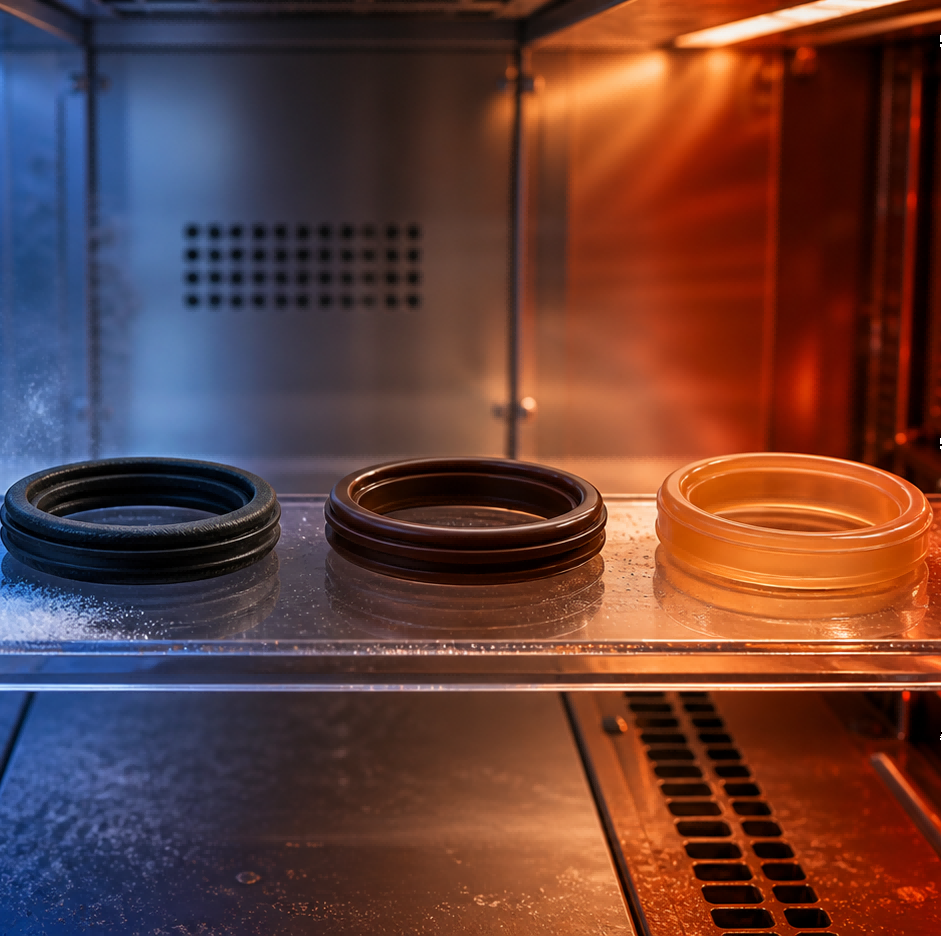
What Cold and Heat Do to an Elastomer
Cold reduces flexibility and recovery speed, Cold weather makes rubber brittle. If pressure opens a hole in the seal, the material is likely to either get compressed or recover too slowly. This means leaking can start before the specimen has completely dried out - sealing relies on good contact rather than being simply dry.
Heat accelerates aging and force loss
High temperature can cause oxidation, crosslinking, chain breakdown, and loss of plasticizers. The seal might get hard or brittle, or even be cracked; a lower force of contact can cause leaks, even if the size is okay.
Thermal cycling adds movement
Rubber, plastic and metal expand to differing extents changing squeeze and clearance.Cycling brings about an additional degree of deformaton, start-up pressure,and viscosity change - hence, the worst may happen during transition, not at any of the dwell points.
NBR, EPDM, FKM and Silicone: A Screening Comparison
Material family | Approximate Parker handbook band* | Useful starting point | Main cautions |
NBR | -34 to 121 C | Mineral oils, fuels and hydraulics. | Cold recovery, heat aging and ozone. |
EPDM | -57 to 121 C | Water, steam and weather. | Petroleum oils; compound-specific steam limits. |
FKM | -26 to 205 C | Heat, oils, fuels and many chemicals. | Cold stiffness and media-specific exceptions. |
Silicone | -115 to 232 C | Broad temperature flexibility; static seals. | Tear, wear, extrusion and permeability. |
These Parker's rubber seal temperature ranges are just ballpark figures. They will get changed a lot by media, and specialty grades will differ too. So if any rubber seal temperature range is used a second time, the test should be one under the actual working condition.
NBR: Good for Oils, but Cold Limits Depend on the Formulation
NBR rubber seals are cost-effective products which provide a good balance for different oils and fuels. A higher content of acrylonitrile makes the fluid resistance of the rubber seal more excellent, yet at the same time, it reduces the possibility of the seal working well in the cold conditions, so nitrile rubber seals of the same rubber hardness may behave differently.
Exposure to elevated temperatures not only increases hardness and set. The seal material must be tested with oil, additives, dwell and life in the planned test. A brief oven test is not sufficient to determine the time needed between seal replacements.
EPDM: Waterproof and Weatherproof – Not Petroleum Oil
EPDM rubber seals possess a good combination of being cold flexible and ozone-resistant, and also they are resistant to weathering and many water-based fluids. Although many water and outdoor applications can be sealed with EPDM, even water and steam at elevated temperatures will cause changes depending on the compound used.
Petroleum oils and fuels are its biggest enemies. Without knowing the details, one EPDM rubber seal could swell and another one get a loss of some of its properties even if both seals were still under the thermal limit, therefore, one needs to keep a close eye on lubes, cleaners, and accidental exposure, too.
FKM: With Outstanding High-Temperature Properties and Cold-Startup Compromise
FKM rubber seals withstand exposure to hot oils, various fuels, and chemical solutions. Most of the time, FKM rubber seals beat nitrile rubber seals at high temperatures. These materials are widely used near engines, pumps, compressors and in process equipment.
Common FKM rubber seals become rigid at cold more quickly, while low-temperature grades are not interchangeable. FKM rubber seals used in hot applications must be tested for steam, amines, bases, and other uncommon fluids, because having heat resistance in no way implies that other properties remain or that the material remains compatible in the long-term.
Silicone: Amazing Flexibility Through a Wide Variety of Temperatures Limited by Mechanical Performance
Silicone rubber seals keep on being elastic in different temperature regimes. It can help with static sealing, hot and cold recovery, and dry heat. However, the claims about regulation or cleanliness shall pertain to a documented formulation and not to a material's appearance.
Due to lower tear, wear and extrusion resistance properties, and also due to the gas permeability feature, the motion, wear and pressure gap areas should be carefully checked by silicone rubber seals.
Example of a real cold temperature problem: CNG Valve Leakage
Towards the beginning, GM issued a bulletin titled '16-NM-121' through NHTSA, which discussed about CNG vent release under extreme cold conditions or during refueling. Fast-fill gas expands which would drop the temperature of the parts down to below -40 C, causing them to get leaked past the O-ring that had become so hard.
The bulletin also reported that leakage stopped above -40 C since elasticity was resumed and that the problem could be worsened by a larger pressure on the dispenser; and besides station checks, the valve was updated where necessary in the case of the latter.
This General Motors case in public is not from Yida. It reveals that ambient temperature is by itself an insufficient guide when gas expansion, pressure, metal temperature and recovery are acting jointly on the seal.
Combining Media and Temperature Evaluation
A hot surface is more susceptible to a fluid attack, and also swelling or extract can take place, while when it is a cold surface, the surface will become more viscous and force will be greater. Besides, the formulation will differ for one case or another, and the same material might exhibit a very different behavior under extreme conditions compared to a more normal scenario. Hence, you should never rely on compatibility data if you don't know what conditions you are dealing with!
What Temperature Specifications Are Showing vs. What They Don't
Reference or test | Question it answers | What it cannot prove alone |
ISO 5119:2023 | Low-temperature gas sealing of the tested static O-ring setup. | A minimum temperature for another size, media or gland. |
ISO 3601-5:2015 | Agreed material specifications for selected industrial O-rings. | Sealing in the buyer's hardware. |
ASTM D1329 | Retraction after low-temperature conditioning. | Leakage or recovery in a compressed seal. |
ASTM D573 | Property change after controlled hot-air aging. | Oil, steam, pressure cycling or a groove. |
ASTM D395-18(2025) | Elastic-property retention after prolonged compression. | Dynamic wear, compatibility or joint leakage. |
ASTM D1414-22 | O-ring properties and aging changes for QC and engineering. | Gland design, assembly protection or field life. |
According to ISO 3601-5:2015, users and suppliers must agree upon the requirements of materials properties, tests and samples to be conducted. Merely stating the polymer name, hardness grade and a generic slab does not adequately describe the sealed material behavior after production.
Temperature validation procedure for a Finished-Seal
Validation must create the exact same situation that could happen in real usage. A stabilized cold dwell might not catch recovery during pressurization, while a short heat rise may overlook time-dependent stress relaxation.
a. Find out the seal temperature as it actually works; there is no use pretending, as ambient or supply temperatures might not coincide with it.
b. Keep the compound, seal, groove, hardware, lubricant assembly method at the exact same limits, i.e., no change in them.
c. Subject complete production seals to the required dwelling time, ideally with actual media if possible.
d. Use released tools, lubricants and as-built hardware of representative assemblies.
e. Run cold start, hot soak, shutdown and cycling in correct-pressure, vacuum or motion sequence.
f. Measure leakage during thermal cycle test and not just after it finishes.
g. Look for signs of set, hardness change, cracking, swelling, extrusion and installation damage.
h. Document the batches and versions and then decide when revalidation is needed for the modifications that you've made.
Purchaser’s guidelines for a Seal Operating at Specific Temperature
Buyer input | Decision-ready detail |
Temperature history | Seal-location minimum, maximum, normal, dwell, ramp, cycles and shutdown. |
Media | Fluid or gas, concentration, lubricant, cleaner and exposure time at each temperature. |
Seal duty | Static or dynamic location, pressure, vacuum, pulses, speed and leak limit. |
Hardware | Size, groove, squeeze, stretch, gap, finish, expansion and tolerances. |
Compound | Exact code, hardness, approvals, traceability and change notification. |
Validation | Conditioning, hardware, sample size, leak method, cycles and limits. |
Collaborating with Dalian Yida on material selection and validation
Dalian Yida Precision Rubber Products Co., Ltd. can evaluate the compatibility with different media, thermal cycle, pressure and vacuum history and other factors related to the design and assembly of the seal. Family selection will lead to an exact compound and controlled process.
Send drawings, information about seal position, measured seal geometry, media characteristics, pressure/vacuum cycle, customer demand and standards. Use of Yida performance claims shall be only when a project approval is available.
Rubber with the highest number won't be the answer but a compound that is able to maintain contact force, recovery and integrity of the joint throughout real conditions. Do the screening, then confirm the compound and finally put it through the whole cycle test.