How compound documentation, cleaning cycles and installed gasket testing determine seal suitability
“Food grade” is a useful starting point when purchasing a rubber gasket. It is not a complete specification. The buyer still needs to identify the compound, intended food contact, cleaning conditions and joint geometry before deciding whether the part is suitable.
A gasket may seal correctly during a short production trial but change after repeated washing. Another may have suitable food-contact documentation yet protrude into the product passage when installed. These are different problems, and they require different evidence.
For rubber seals for food processing, purchasing approval should connect the material documentation with the component drawing and an agreed validation plan. A certificate answers only part of the question.
When discussing a project with Dalian Yida Precision Rubber Products Co., Ltd., provide the seal drawing, mating joint details, destination market and full operating sequence together. This gives the discussion a practical basis without assuming that a familiar rubber type will suit every application.
What belongs in the specification
The seal does not experience production and cleaning as separate projects. It remains in the equipment while the product, temperature and chemicals change around it.
A valve gasket might contact a fatty ingredient, receive a hot detergent wash, undergo rinsing and then cool before the next batch. A specification covering only the production temperature misses much of that duty.
The information below helps turn a general inquiry into a reviewable application.
Specification area | Information to provide | Why it matters |
Food contact | Product type, fat content, acidity, contact duration and temperature | Defines the relevant exposure and documentation scope |
Cleaning and sterilization | Chemical names, concentrations, temperatures, dwell times and frequency | Allows assessment against the actual cleaning recipe |
Mechanical operation | Pressure, vacuum, movement, stroke and operating frequency | Identifies loading, friction and deformation requirements |
Joint geometry | Seal drawing, groove dimensions, mating surfaces and assembly method | Establishes compression, fit and potential product traps |
Purchasing acceptance | Destination market, documentation, tests and replacement expectations | Makes approval criteria clear before production |
Exact chemical names are more useful than “alkaline cleaner” or “sanitizer.” Likewise, the maximum temperature alone does not describe exposure time or the number of cycles.
Include shutdown conditions where relevant. Even if you seal your product off and let it sit for a day or two, your rubber may contract and your metal seal will change. That change of contact pressure can result in different outcomes even if your production is running normally.
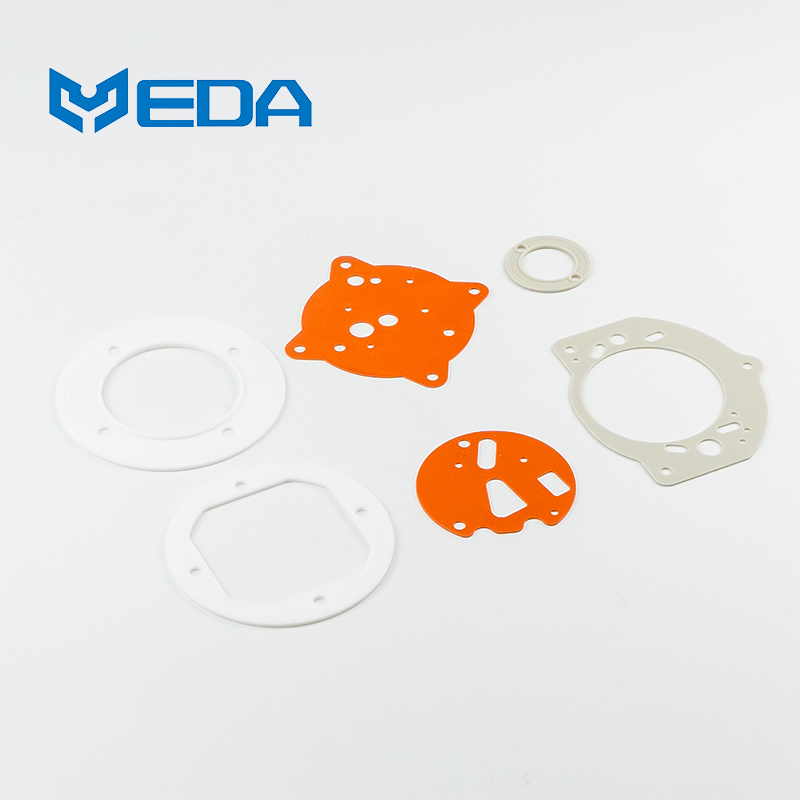
What an FDA compliant rubber gasket actually means
American regulations cover rubber used for repeated use under 21 CFR 177.2600. Formulation ingredients and extraction requirements have to be met and they have to be specified under certain conditions in the documentations. The paper should state, the chemical makeup of the rubber compound to be delivered and the range that the rubber has to comply with 21 CFR 177.2600
This means that “FDA compliant rubber gasket” can be viewed only as a compliance statement with limited scope and it does not indicate nor mean that FDA has approved the particular gasket design or certified its service life.
Such regulation neither defines pressure capability, fatigue resistance, nor cleanability of the equipment assembled. These aspects should be studied separately in each application.
Rather, EU legislation No 1935/2004 provides the overall framework for food contact materials that are used. It says that under expected or normal conditions, these materials must not release substances that pose a health risk. In addition, that they don't affect the characteristics of food, i.e. taste, look etc., in any unacceptable way.
The framework is more a guideline indicating the steps of the approval process or mechanical qualification. Material-specific and national laws applicable in the end country must still be checked to determine their compliance.
Buyers of rubber components which come into contact with food should discern these levels of evidence from merely obtaining certificates that they then do not really check what they include.
Evidence | What it can support | What it does not establish by itself |
Documentation addressing 21 CFR 177.2600 | Relevant formulation and extraction compliance for repeated-use rubber articles | Installed sealing performance or equipment hygiene |
Assessment against Regulation (EC) No 1935/2004 | Applicable general food-contact safety requirements | Complete approval of every rubber formulation |
Compound exposure testing | Material changes under the reported test conditions | Performance under a different cleaning recipe |
Assembled joint testing | Leakage, deformation or other measured behavior in that assembly | Cleanability unless cleaning is also assessed |
Keep the compound designation linked to the supporting documents. “EPDM” or “silicone” alone is not enough to identify a formulation because additives and curing systems can differ within the same material family.
A recall illustrates why physical integrity matters
On January 29, 2019, USDA FSIS announced a recall of approximately 36,420 pounds of Tyson chicken nugget products because they might contain extraneous material, specifically rubber. This was the quantity stated in the original announcement. USDA FSIS recall announcement
The notice does not identify a failed gasket as the source. It would therefore be inaccurate to present this as a confirmed seal failure.
The relevant lesson for component purchasing is narrower: rubber contamination is a real food-production concern. Chemical suitability alone does not address the risk of physical damage or loose fragments.
Seal inspection should consequently look beyond leakage. Broken surface cracks, torn edges, and wear marks are just signs of the surface of the problem because sometimes there is still enough material present to maintain pressure.
A well-planned maintenance check schedule that can be tailored to each application is the main factor for the success of a good sealing system.
Resistance of Cleaning Process Needs to Be Based on Specific Recipe
Cleaning in place (CIP) is defined as cleaning of equipment without disassembly during normal operation. On the other hand, sterilization in place (SIP) serves a different function and involves exposure profile which needs to be identified separately. In areas where both CIP and SIP are applied, records of both operating cycles should be kept.
If one only talks about "CIP Resistant" seals, such a term is incomplete unless one specifies chemical concentration, temperature, and exposure time. A cleaning procedure tested using only one kind of detergent cannot be the basis for saying the sealing material is resistant against all cleaning products.
Sealing materials are sensitive to factors like changes in volume, change of water hardness or even minor mechanical degradation that may affect rubber in a way which causes swelling that in turn might increase the compression or result in rubber being pushed into a passage. Shrinkage on the other hand might reduce the contact at the sealing surface.
A test methodology that takes into account the complete cleaning sequence including product contact, washing, rinsing and cooling stages is more helpful than those considering only isolated cleaning steps. A cleaning sequence where the equipment is continuously immersed in one cleaning agent may produce a different result compared to those that follow a sequence of several cleaning steps.
If the cleaners used in a facility get changes either due to switching over to a different cleaning chemical or the wash temperature gets increased, then the seal specification needs to be examined again.
Chemical compatibility and food-contact documentation need to be reviewed side by side for the rubber parts that are in contact with food. Neither of them should be used as a substitute for the other.
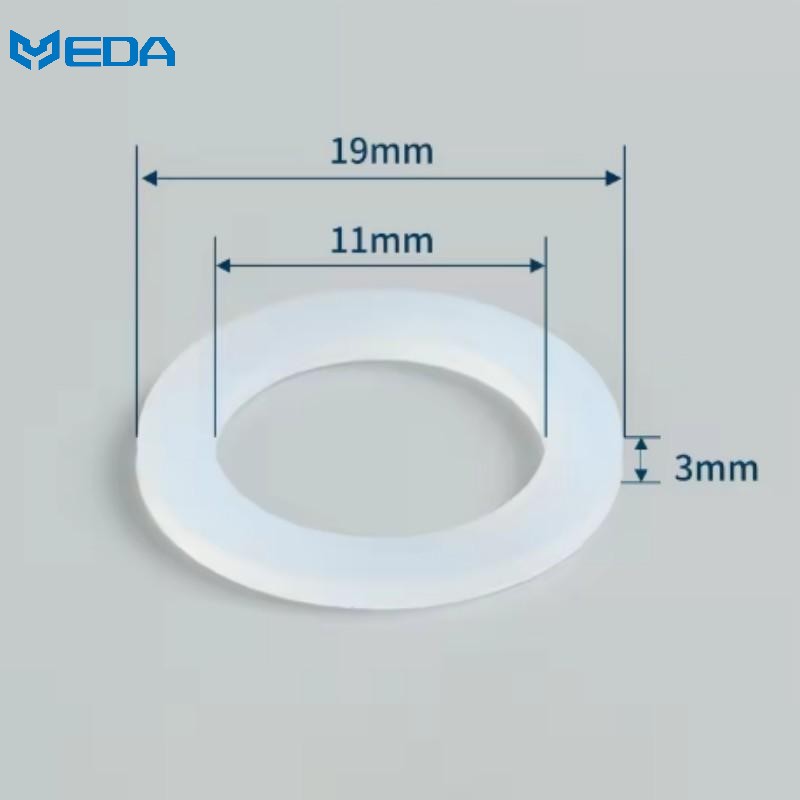
A sanitary gasket must fit the joint after cycling
A smooth gasket surface does not guarantee a cleanable connection. Recessed edges, exposed grooves and protruding rubber can create locations where product remains.
Hygienic seal design therefore concerns the whole joint. Review how the gasket sits between the mating parts, how its compression is controlled and how dimensional variation affects its exposed edge.
A published study in ISPE’s November–December 2002 Pharmaceutical Engineering examined sanitary fittings under thermal cycling. The test assemblies used EPDM, silicone, FKM and PTFE gaskets. The reported schedule included heating to 121°C, holding at temperature for 30 minutes and cooling, repeated for 250 cycles. ISPE thermal cycling study
The study compared an ISO 2852 fitting with an alternative fitting designed to control gasket extrusion. Its results showed that fitting geometry affected gasket intrusion into the bore during cycling.
This was a pharmaceutical fitting study, not a food-processing customer trial. The 250-cycle schedule is not a universal service-life requirement, and it does not guarantee that another compound or joint will perform similarly.
The transferable engineering point is that material selection cannot be separated from containment and assembly. A satisfactory initial seal does not necessarily remain in the same position after repeated thermal exposure.
For hygienic seal design, inspect the assembled joint before and after representative cycling. A free-standing sample cannot reveal every issue at the gasket-to-metal interface.
Validate the part that will actually be supplied
Material tests are useful for screening compounds. Production approval should then move to the finished molded component and its intended assembly.
Check critical dimensions, flash at functional surfaces and installation behavior. A gasket that twists or fits inconsistently can introduce variation before the equipment starts operating.
Use representative mating parts where possible. Agree the assembly method and acceptance limits before testing so that the result is not judged against criteria chosen afterward.
Suggested validation flow
Application and market review
↓
Compound documentation and drawing review
↓
Molded sample inspection and trial assembly
↓
Representative product cleaning and thermal cycles
↓
Leak testing cleaning assessment and disassembly inspection
↓
Approval of the specification and production controls
This is a proposed project sequence, not a regulatory test method. The equipment owner and component supplier should agree the relevant conditions and responsibilities.
Validation stage | Practical checks | Acceptance basis |
Incoming sample | Dimensions, surface defects and compound identification | Approved drawing and inspection criteria |
Trial assembly | Fit, installation damage and gasket position | Defined mating parts and assembly method |
Exposure testing | Swelling, hardness change, cracking or deformation | Agreed fluids, temperatures and duration |
Operating test | Leakage, movement and wear where applicable | Defined pressure, motion and cycle conditions |
Cleaning assessment | Retained soil and accessibility of the joint | Equipment-specific cleaning validation |
Post-test inspection | Extrusion, damaged edges and permanent deformation | Agreed rejection criteria and maintenance needs |
A pressure test cannot demonstrate that the joint is clean. Cleaning assessment must examine whether the intended procedure removes relevant residues from the equipment.
Likewise, a short successful trial should not be presented as proof of long service life. The test report should state what was tested, under which conditions and for how long.
Once approved, the component should remain linked to its validated specification. Changes to the compound, critical dimensions or manufacturing process need review before being treated as equivalent.
Preparing a project for Yida
An inquiry for custom food processing seals is easier to evaluate when the drawing and application information arrive together. Include the mating groove, food-contact surfaces and any dimensions that directly control compression.
For a project discussed with Yida, identify the compound requirements, destination market and operating sequence early. Supporting documentation and any required testing should be agreed for that specific application rather than assumed from a general material description.
Replacement practices are also worth sharing. A seal removed daily for manual cleaning has different handling demands from one left installed between scheduled shutdowns.
Custom food processing seals should ultimately be approved against a defined combination of material, geometry and duty. The purpose is to obtain a component that fits reliably and remains suitable through its intended use.
When purchasing rubber seals for food processing, keep the final question practical: does the evidence support this compound, in this joint, under this production and cleaning cycle? That is a stronger basis for approval than the words “food grade” alone.