FFKM O-Rings for Extreme Temperature and Chemical Resistance
The question that the engineers should ask themselves before using FFKM for a sealing function that may be dangerous in case of a leak is "Does FFKM really need to be used here?"
There are various steps for a seal. It might meet a hot solvent at one point of the time, a cleaning by steam, and another cool down between the production cycles. If that was the case, the seal material is a major factor because it determines if the sealing function would continue to be fulfilled after exposure to different conditions.
FFKM sealing rings are considered only when ordinary elastomers cannot offer adequate chemical or thermal resistance. The FFKMs unite a seal's elasticity with a highly fluorinated polymeric backbone. FFKMs prove to be the most economical sealing solution in leakage critical seal applications.
FFKM also belongs to the group of elastomers known for exceptionally high prices. Therefore, their grades must not be considered interchangeable. A thoughtful specification must raise two questions: Is FFKM really necessary since a suitable FK M or another elastomer can be used? If so, then what FFKM compound matches the given exposure?
What Makes FFKM Different From FKM
Perfluoroelastomer under the classification used in ASTM D1418 means that FFKM is used for. So, the FFKM is the designation and not the compound name by itself. Depending on a combination of fillers, crosslinking agents, and formulations, you can alter the properties of compression set, high-temp performance, low-temp resilience, purity level, and specific chemical resistance.
Fluorination to the level found in FFKM offers it the chemical resistance needed even to the most aggressive fluids. Parker says that FFKM has chemical properties comparable to those of PTFE and has the elasticity of FKM. Although elastomers can deform, age, etc., they must be squeezed in a controlled fashion.
It is a fact of selecting FFKM sealing solution when there are chemical/temperature conditions combination that may cause a sealing problem i.e., unacceptable swelling, hardening, compression set or property loss in less expensive materials, or when the seal can have a clean process or longer downtime, which justifies replacing the lower-value seal with a high-value one.
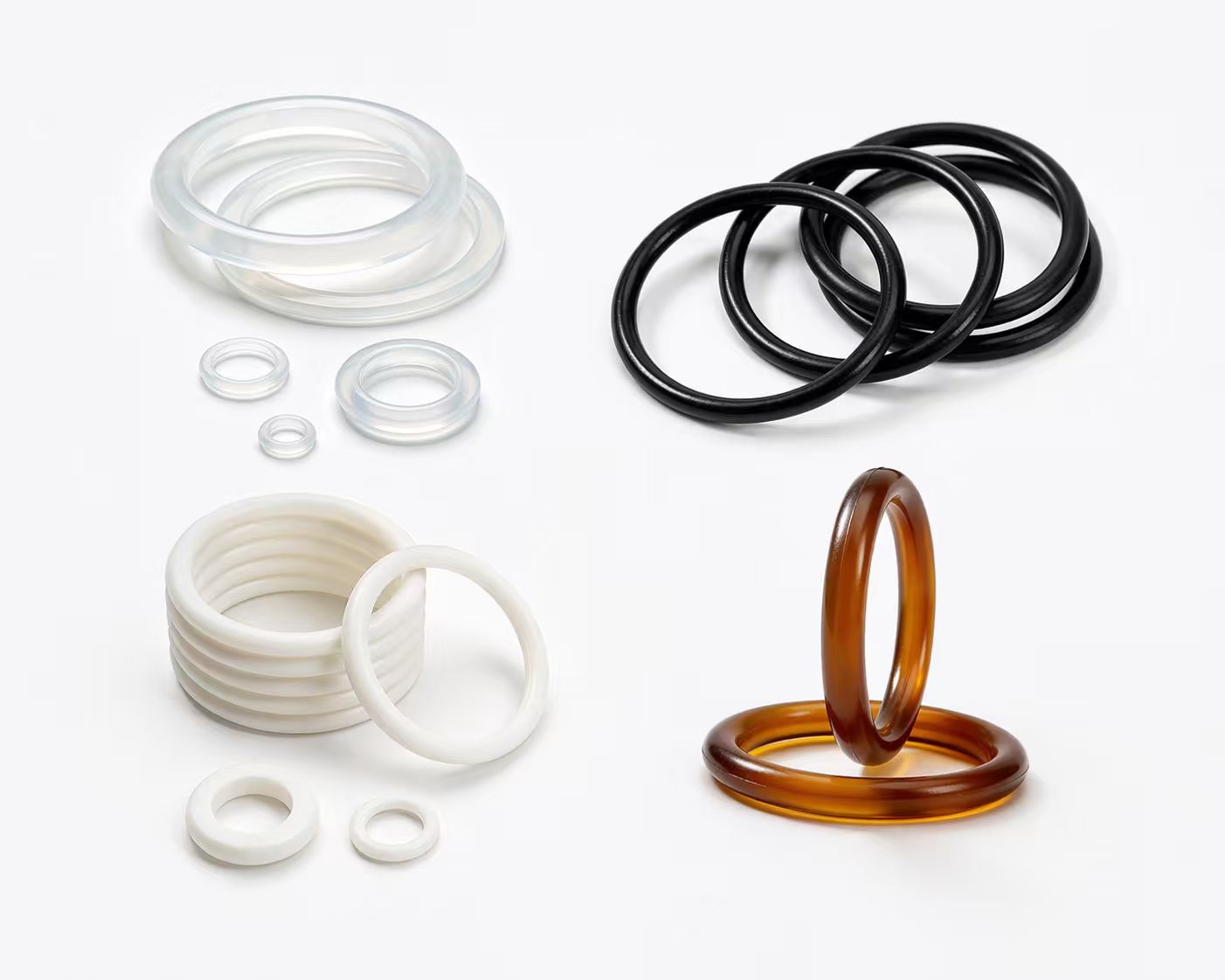
Temperature Ratings Need Context
Floating upper temperature values differ per grade.
Parker's European O-ring guide gives an approximate upper limit of about310°C for theFFKM family, whereas different O-ring suppliers list very different upper limits.
To be safe such numbers have to be checked against one's material formulation as they are not general rules.
Seals exposed to extreme temperatures behave differently under the influences of both heat and time. A brief heat spike is totally different from a consistent temperature elevation. At this increased temperature, compression set, chemical degradation and loss of the physical properties can all happen and get worse quite fast.
Seal integrity might still be there, even as it starts leaking because contact force has been greatly reduced.
We cannot afford to ignore low temperature, however. Some fluorinated FFKM materials are so brittle and/or non-elastic at low temps. that they don't work at all with a cold joint. Usually printed cold resistance ranges of fluoroelastomer types are narrower than the cold performances of a high quality material that a user is actually expecting. Maybe the governing condition here is the start-up after a cold shut-down.
Chemical Resistance Is Grade Specific
To ensure longevity and reliability chemical resistant O-rings have to be selected with respect to the particular working fluid instead of just using broad labels like acid/alkaline, solvent/diluent or cleaner/disinfectant etc.
The level of strength/potency, the amount of liquid/wetness, the exposure temperature, pressure, and other impurities, all can change the nature of this exposure. Chemical resistance can be estimated via compatibility chart, but the chart cannot replicate every possible combination and situation a fluid can be present in.
Pickled steel is one of many such materials and chemicals that require careful consideration of material resistance to its effects in different ways. In some cases, materials have been adapted for such situations, whereas in other cases, materials have not been chosen to be used in the pickling solution. Fluorinated fluids, similarly to some amines or esters, might also be problematic for some elastomers to be in contact with. Fluorinated elastomers is not a name under which one can be assured that the material would be suitable. One needs to find the right grades.
Public comparison proves why choice of compound is important
A comparison performed by a company published their results of immersion testing at various photovoltaic cell manufacturing processes by using O-rings AS568 K214 made of Fluoroelastomer. After immersing 30% potassium hydroxide at 80°C for 168 hours, a 66.9% volume increase and too brittle of the tested material for a few retained-property measurements were observed.
On the same condition, two tested fluouroelastomer with perfluoro group materials (FFKM) showed changes of volume of about 0.3% and even slightly -0.5%. These results seem to support the use of FFKM as a candidate for that chemical environment, but they do not determine the service life in every seal design, pressure or process cycle.
The same publication mentioned a considerable difference between FFKM formulations at 49% hydrofluoric acid at 80°C. One formulation had a change in volume of 1.6%, while the other one was 13.1%. The latter case of FFKM being less chemically-stable is evidence that materials from the same family designation respond differently.
The point is to show that chemical resistant O-rings have to be chosen based on individual compound data. The figures by DuPont are supplier-reported lab results not Yida customer results, and hence the tested conditions shall be compared carefully with the proposed application.
Design of Groove Still Maintains the Seal
An ultra-resistant rubber compound will be of no use if groove is incorrect. The O-ring should be compressed to a minimum degree to have contact without causing an unnecessary amount of stress. The groove must allow for enough clearance so the O-ring expansion caused by temperature changes is not impeded and also that fluid-induced volume change is accommodated. Tolerance stack-up should be checked at each extreme of dimensions.
Surface finish influences the level of friction and leakage paths. A rough surface will wear out the seal whereas if machining marks are inappropriate as direction for the flow then the sealing layer may wear down faster. Sharp installation edges, ports and threads are best protected with leads or assembly sleeves.
Dynamic application requires a separate evaluation. Reciprocating or rotating motion produces heat, friction, and wear which static immersions are not able to capture. Compound, lubrication, surface conditions, speed and pressure should be tested together first, before cycle life can be claimed with any confidence.
What the Standards Do and Do Not Prove
ASTM D1418 standardizes rubber abbreviations and includes FFKM in its nomenclature. It tells engineers what the family designation means. It does not define one universal FFKM performance level, chemical range or service temperature.
ASTM D471 provides controlled methods for measuring the effect of liquids on rubber. ASTM states that the method produces comparative data and may not correlate directly with actual part performance because service conditions vary widely. That limitation should remain visible in any test report.
ASTM D395 measures the ability of rubber to retain elastic properties after prolonged compression and is mainly applicable to static stress conditions. A good compression-set result supports material screening, but it does not prove leakage performance in a particular groove.
ISO 3601-3 defines and classifies surface imperfections for standardized O-rings and sets acceptance limits. It helps control molded quality. It does not establish chemical compatibility, temperature capability or the life of an assembled sealing system.
A Practical Approval Sequence
Begin with an application record. List every process fluid, concentration and possible mixture. Add lubricants, cleaning agents and residues. Record minimum, continuous and peak temperatures, pressure, vacuum level, motion, cycle time and expected maintenance interval.
Next, screen candidate compounds using supplier data and targeted immersion testing. Use the actual fluid where safety and control allow. Measure the property changes that affect the design, and agree on acceptance limits before testing rather than judging the result afterward.
Inspect molded dimensions and surface condition against the drawing. Assemble parts using the production method and representative mating hardware. Confirm that the O-ring is not twisted, cut or pinched, and that the lubricant and installation tools match the intended process.
Then test the sealed assembly through representative thermal, pressure and chemical cycles. Measure leakage or another defined function during the demanding stages. After testing, inspect for permanent deformation, cracking, extrusion, adhesion, deposits and surface attack.
Extreme temperature seals should also be reviewed after any change to compound, supplier, cure, post-cure, tooling or critical dimensions. A change that appears minor in purchasing records can alter compression behavior, cleanliness or chemical response.
When the Higher Material Cost Can Make Sense
FFKM may be justified when seal failure can contaminate valuable product, create a safety concern, stop a continuous process or require difficult equipment access. In those cases, purchase price should be compared with maintenance labor, lost production and failure consequence.
It may be difficult to justify where the service conditions are moderate, replacement is easy and a proven FKM already meets the required interval. An application review should identify which exposure defeats the lower-cost option. Without that reason, premium material becomes an assumption rather than an engineering choice.
Custom FFKM seals can be appropriate when a standard O-ring cannot provide the needed geometry, gland arrangement or integration. Custom design also increases the need for dimensional review, tooling control and finished-part testing because catalog data may be based on a standard specimen.
Working With Yida
Dalian Yida Precision Rubber Products Co., Ltd. supports customer-defined precision rubber components, including custom FFKM seals for demanding applications. We review drawings, operating conditions and inspection requirements so that material discussions stay connected to the actual part.
FFKM material selection should end with an approved compound and a documented validation plan. No supplier name, polymer abbreviation or maximum-temperature figure can replace that work. The best result comes from matching the grade, geometry and test conditions to one clearly defined sealing position.
When those details are established, FFKM O-rings can provide a valuable option for environments that exceed conventional elastomer capability. The decision is strongest when it rests on compound-specific evidence and finished-part performance rather than the reputation of the material family.