Cold, Not Cracked: Why O-Rings Leak Before They Become Brittle
The '-40 Degrees C' Line Is Not a Test Plan
Material report describes that the compound met a -40 C degree brittleness requirement. However, valve leaks just at the beginning of a cold start and seals itself when warmed up. The difference is very well explained by the standardization activities: the ASTM reconfirmed D2137-11(2025), the ISO confirmed ISO 2921:2019 in 2024, and ASTM issued WK97337 in 2025 to revise D1329. None, of course, gives the low-temperature O-rings service limit which would be valid universally.
For purchasers, one essential thing is to know which failure mode a test reveals.TR10 test is one kind of testing method used to describe retraction; brittleness is the fracture test.Unfortunately, none of the two can be used for guessing the cold seal performance of a joint undergoing movement at the time when the machine or the system starts.This factor is mainly determined by how flexible the elastomer is after being stretched or pulled and how fast the metal parts separate or unfold.
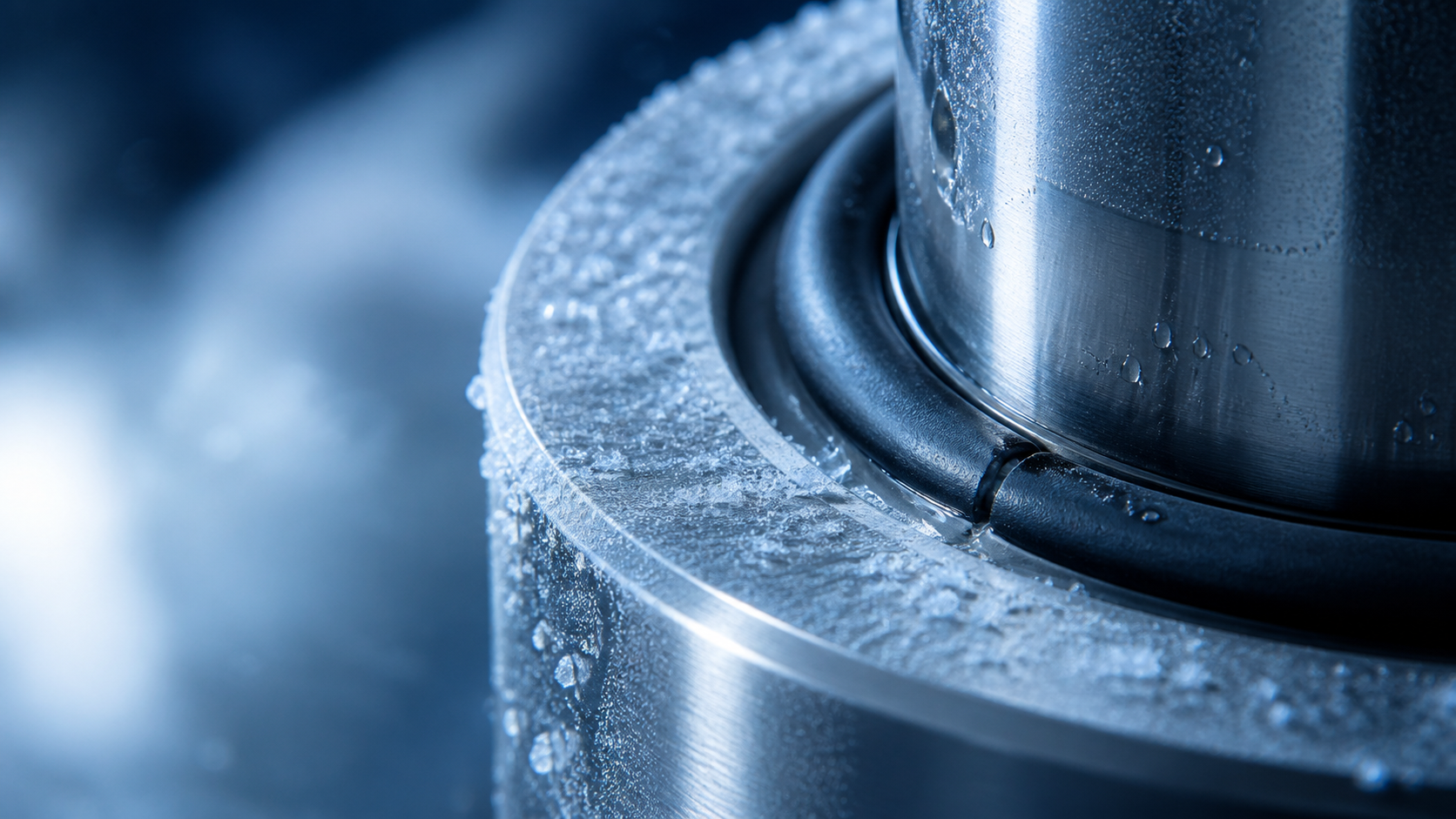
A Temperature on a Drawing Is Not an Operating Limit
The temperature rating is given as a note 'brittleness: -40 degrees C'. It seems very accurate. Actually, most of the applications are not defined. The temperature for rubber brittleness will have no influence on the fact that pressure has risen and grooves moved, it is not also related to cold-soaking time or permissible leakage. It is these factors that finally determine the suitability of low-temp. rubber seal O-rings to maintain seal after the apparatus has been run.
Consider a face seal that remains compressed throughout a cold soak. It may stay tight.
For this scenario, place the identical compound in a radial gland with flexible parts that are able to change shape with pressure fluctuation and the variation in the job conditions. For instance, when the metal moves against the rubber, the rubber does not just stop its movement, the rubber needs to continue moving with the metal to some degree. If the width of the space increases more quickly than the ability of the elastomer to close the gap back to the initial state, then, the possibility of a leak will arise as the sealing ring appears perfectly fine even after the system has been brought to its operating warm-up.
This is why cold seal performance needs an operating definition. Does suitable mean no visible damage, no bubbles, a maximum measured leak rate, or recovery within a stated time? Without a method and an acceptance limit, 'suitable to -40 degrees C' is a sales phrase rather than a testable requirement.
Brittleness Tests Screen Fracture - Nothing More
ASTM D2137 and ISO 812 expose conditioned specimens to a defined low-temperature impact. The outcome is useful, but narrow: did the specimen fail under those test conditions? Both standards caution that a measured rubber brittleness temperature should not be read automatically as the lowest service temperature.
Details change the result. Specimen shape, deformation, impact speed, and conditioning all matter. So does the way the number was reported. A pass at one specified temperature is not the same result as a temperature calculated at 50% failure, and a standard specimen is not a finished molded seal.
A rubber brittleness temperature is therefore a screening result, not a complete seal rating. It can help reject a compound that is prone to impact fracture. It cannot show whether a squeezed ring will rebound quickly enough after a flange, shaft, or piston moves. The part may remain unbroken and still lose contact for a fraction of a second.
TR Data Adds a Recovery Curve
TR10 testing asks a different question. Under ASTM D1329 or ISO 2921, a stretched vulcanized-rubber specimen is frozen, released, and then warmed while its return is recorded. TR10 marks 10% retraction; TR70 marks 70%. Instead of a single fracture event, the test produces a recovery curve.
The curve can reveal viscoelastic or crystallization behavior that room-temperature hardness will miss. ASTM notes a relationship between TR70 and low-temperature compression set. It also notes that TR10 may correlate with brittle points when vulcanizates are based on similar polymer types.
The words 'similar polymer types' matter.
Two compounds with almost the same TR10 value can have quite different reactions when fluid swell, modulus, aging, and groove squeeze come into play. Comparing results obtained from different specimens or conditioning is even more challenging. The TR10 test helps a lot to reduce the list of materials. However, it cannot replace a proper test of the joint after manufacturing through the actual cold cycle.
Glass transition is part of the story, not the whole story
The glass transition is a phenomenon taking place within a temperature area, not suddenly at a fixed point. One should remember, though, that different results will be observed when changing the rate, recipe, or cure. ASTM D1053 is a method of torsional stiffness measurement carried out as the specimen cools; ASTM D1229 focuses on low-temperature compression set at the moment of release. Along with TR data, these methods aid in distinguishing between stiffening, slow return, and permanent loss of shape.
Challenger: The Gap Opened Faster Than the Seal Could Follow
The Challenger record is useful because it shows how much can be hidden by the phrase 'cold O-ring.' The Rogers Commission did not describe a simple case of rubber shattering. It found a pressure-seal design that was unacceptably sensitive to temperature, dimensions, material response, reuse, processing, and dynamic loading.
On launch morning the ambient temperature was 36 degrees F. The coldest point on the failed joint was estimated at 28 plus or minus 5 degrees F. At ignition, the joint gap began to open. Its opening rate peaked at roughly 200 to 300 milliseconds, and the gap was essentially open by 600 milliseconds.
The seal had almost no time to catch up.
Tests by the Panel revealed a surprising detail: an O-ring, compressed and then allowed to decompress, returned to its round shape in about one fifth of the time as a similar O-ring which had been tested at the lower temperature of 30 degrees F. This result was very important in support of a theory that had been proposed some time earlier namely that in very cold conditions, rubbery sealing materials would be too slow in closing a moving gap to prevent a leak. The actual mechanism was the loss of shape of the seal and the timing sequence of seal compression, pressure, movement, and so on.
NASA later tested a particular Viton V747-75 compound in redesigned joint fixtures. Temperature mattered, but so did groove finish, gap, and foreign material. Those results are valuable evidence about cold seal performance in that setup. They are not a blanket temperature rating for every FKM compound or for all low-temperature O-rings.
Inside a Cold Joint, Several Things Move at Once
Cooling affects not only the rubber. Metal and elastomer contract at different rates, therefore seal squeeze can increase in one gland and decrease in another. Tolerances change. Nature of surfaces contact differs. A tolerance accumulation that seems acceptable at room temperature could get very tight after a prolonged cold soak.
The timing of pressure is equally important. Some types of seals rely on pressure to drive a seal ring towards the side of its groove with low pressure. If the joint shifts while there is still a time for pressure to cause that seal to tighten, the first thing may be getting water under the seal. Also if cold stiffening makes sliding or assembly force higher than normal, the movement of the hardware can get affected.
Material family alone cannot settle the choice. NBR, FKM, EPDM, silicone, and fluorosilicone cover wide formulation ranges. Compound-level stiffness, fluid resistance, aging, and rebound vary. Geometry then uses that balance: squeeze, stretch, clearance, and surface finish all affect contact. Elastomer recovery may be adequate in a static face seal and too slow in a lightly squeezed radial gland.
Test the Cold Start, Not Just the Cold Part
Begin with the coldest condition the seal will actually see, not only the weather forecast or chamber set point. Local metal can run below ambient, and a long soak is different from a brief dip. Record the fluid, pressure, dwell time, pressure-rise rate, movement, and number of thermal cycles before choosing a laboratory method.
Use early tests to remove unsuitable candidates. TR10 testing can compare retraction behavior, while stiffness and low-temperature compression-set data answer related questions. Then put the short list into production-representative grooves. For low-temperature O-rings, the hardware dimensions and surface finish belong in the test plan, not in a footnote.
The last test should reproduce the moment most likely to fail. Condition both seal and hardware, then run the real pressure ramp and movement sequence while the assembly is still cold.
Measure leakage during start-up, not five minutes later after the rubber has warmed. That is the evidence that speaks directly to cold seal performance.
Write an RFQ a Laboratory Can Actually Test
A useful RFQ names the compound or approved material specification, hardness method, fluid, pressure, motion, groove dimensions, temperature history, and required life. When a TR value is required, identify ASTM D1329 or ISO 2921 along with the retraction point, specimen, conditioning, and acceptance limit.
If the specification calls out a rubber brittleness temperature, state how the result will be reported. 'No leak' also needs a pressure, medium, method, duration, and allowable rate. Add the sequence: a seal that is cold-soaked, moved, and pressurized within seconds has a different duty from a static gasket held under pressure. Writing down that order often reveals the acceptance test before samples are ordered.
Before Sampling: What Yida Would Ask
For a new low-temperature O-rings project, Dalian Yida Precision Rubber Products Co., Ltd. would begin with the drawing and the operating sequence. The review covers the fluid, pressure, motion, groove, cold-soak time, and the few seconds around start-up. Those inputs are more useful than a catalog minimum on its own.
Yida is able to examine compound evidence which is specific to the compounds, dimensional control of compounds and how TR10 testing will play into the situation. If there is doubt about material failure in the seal area, the ultimate leak test should be identical to the customer hardware and it should take cold seal performance measurements firsthand.
Please provide us with a drawing, operating conditions, quantity, and the latest test requirements. After that, Yida can go through the rubber brittleness temperature requirement and reach an agreement on the evidence of rubber recovery before sampling.