Automation Growth Is Driving Demand for Customized Rubber Components
Reading robot installation data through the less visible seals grippers cushions diaphragms and flexible interfaces inside each cell
Robot shipment data counts visible machines. It does not count the small seals, suction interfaces, cable grommets, bumpers, diaphragms and vibration elements that allow those machines to work in dust, coolant, heat or rapid motion. Many of these parts are shaped around one cell or end effector.
Automation rubber component demand grows because equipment is becoming more specialized. A standard arm may serve several industries, but its gripper, fluid circuit, guarding and process interface change with the product being handled.
The Current Installation Base
The International Federation of Robotics reports that 542,000 industrial robots were installed worldwide in 2024, more than twice the level ten years earlier. Annual installations exceeded 500,000 for a fourth consecutive year, and Asia represented 74 percent of new deployment. [1]
The same dataset shows different demand by industry. Electrical and electronics recorded 128,899 installations in 2024, automotive 126,088, metal and machinery 88,777, and plastics and chemical products 26,491. Each group exposes components to different media and motions. [2]
At the End Effector
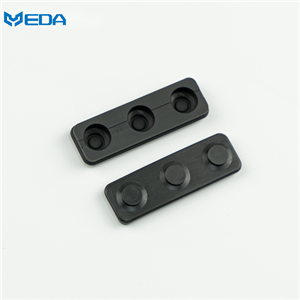
Robotic equipment rubber parts include suction cups, compliant fingers, pads and bellows. The rubber must grip without marking, recover at the cycle rate and tolerate product dust or cleaning chemicals. Geometry often follows the handled item rather than a standard catalogue size.
Customized rubber components can place vacuum channels, sealing lips and stiffening ribs inside one molded form. The design should still allow cleaning, inspection and replacement. A complex cup that hides cracks may create unplanned downtime.
Inside the Pneumatic and Fluid Circuit
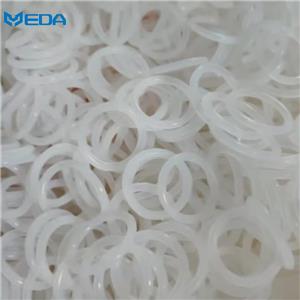
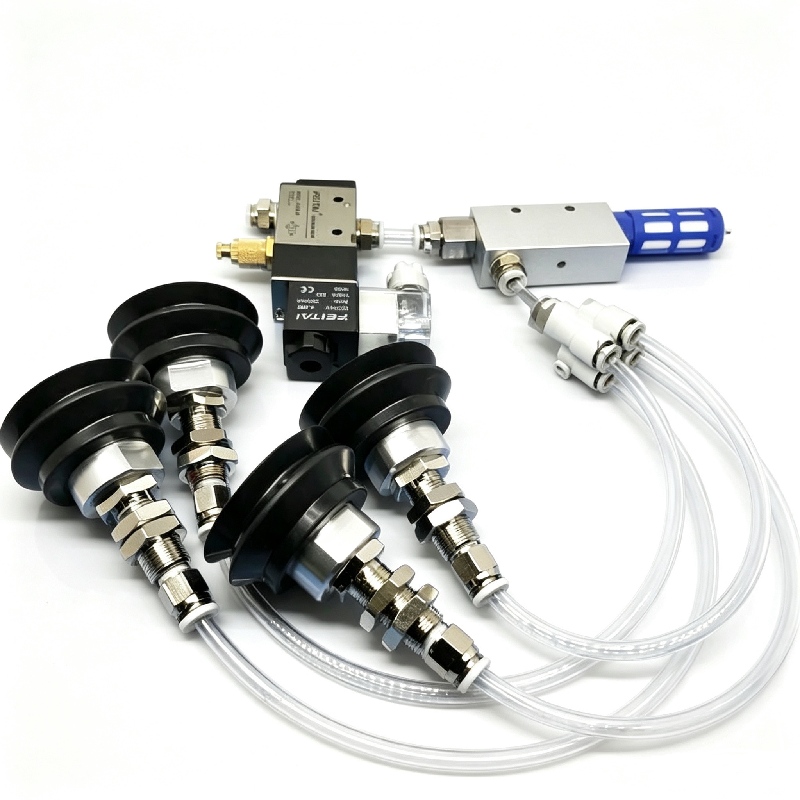
Industrial automation seals work in cylinders, valves, manifolds and quick connections. Higher cycle rates can increase frictional heat and wear. Intermittent pressure, dry starts and compressed-air lubricant change the duty from a static bench test.
A pressure regulator diaphragm may need uniform thickness and low hysteresis. SIMTEC notes that LSR membranes can be molded as thin as 0.15 mm for pressure sensing, while thickness distribution and assembly distortion affect response. [3]
Around Sensors and Electronics
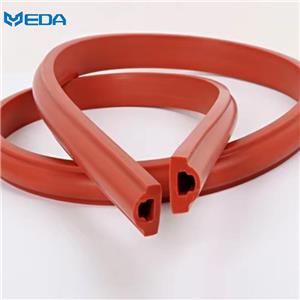
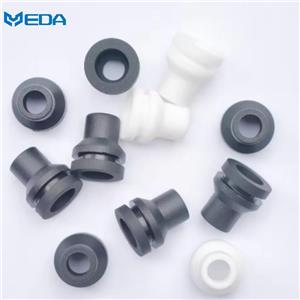
More sensors create more openings for cables and connectors. Grommets and enclosure seals protect against coolant spray, washdown and dust while allowing assembly. A retained or bonded design may reduce the chance of missing a loose seal during automated installation.
Rubber parts for automation near cameras or optics may also need particle and volatile-residue limits. The room where the part was molded does not define the delivered surface. Cleaning, post-cure and packaging should be specified separately.
Between Machine and Floor
Mounts and bumpers serve to manage vibration, impacts, and energy at the end of a stroke. If motion becomes faster, it might either shift the disturbing frequency or simply add to the impact energy. A part used for a particular machine speed rate will probably no longer be able to handle the same band of frequencies after the machine has been upgraded.
The automation market's demand for rubber parts will not only be based on new equipment. It will include redesign and replacement too. New sensors installed through retrofitting, large payloads and fast recipes can change the load, temperature or chemical exposure around previously installed rubbers
Customization Needs a Stable Input
The word Custom shall not be interpreted as undefined. It is necessary to record mating geometry, force or pressure, motion trace, environment, cycle life, assembly method and inspection limit. These parameters give a supplier a choice which to go for, unique geometry which adds value or a standard seal which remains safer.
Industrial automation seals, for example, shall include normal and upset conditions. Such as emergency stops, air loss, jam, cleaning and long idle periods can cause the highest strain or chemical exposure even though these conditions are not a part of the standard cycle.
A Practical Qualification Route
Robotic rubber parts that are just a concept should be able to address a very specific question, e.g. is the right force obtained at the point where the object is grasped? Will there be any leak after sealing? Production-intent samples will require the cavity to be known, as well as the compound and manufacturing process followed. These will then be tested while undergoing normal operation and cleaning procedures.
Results of test can also be obtained in the form of time-lapsed video if not done during the test period. The use of vacuum tests is one of the best ways to determine seal leakage while using it as a reference. For other things like the insertion force of a seal during a particular step as well as the reaction time, these aspects can be determined and checked through video. The change in temperature and the vibration levels can also point out the degradation of the seal long before it can be seen by the human eye. The inspection of the sealing faces and areas with the highest degree of deformation after disassembly should be done.
Rubber seals for automating systems are employed for the second purpose - integration. These bonded carriers or molded locating features can make it easier for robotic arms to grip, but adding a new contact surface requires bond and clearance validation. The production cell and the component should be released at the same time.
Stock planning and forecasting should clearly define quantities of a prototype, ramping up the production, and stable production. A high-cavity tool may save unit conversion costs at large volumes, but it might also add balancing and inspection jobs that might be unnecessary for the evolving early designs. Tooling policy should reflect the program's actual customer orders history.
Maintenance teams are another end-customers of a component. The replacement path for a custom boot or bumper should be clearly understood as well as how to orient and the features to inspect. If one component version can be used in the same location as a couple of others, then the labeling system must not allow a wrong hardness or geometry to reach the machine.
On design, supply continuity factors also play a role. The compound supplier approval, the shelf life of the compound, the ownership of the tooling and the spare strategy should definitely be included. If the process for production is very complex for a part and it is not documented, there is high probability this part alone may cause more than the replacement part's downtime which had previously existed.
Lastly, review the machine-level cost. The removal of fixture, tool change, manual assembly etc. and the reduction in sensor and maintenance efforts should be included in the calculation. A part which only requires an imprint to be made will not bring enough value for a production facility to switch from the standard part. However, a customized part is worth the effort only if its extra cost compared to a standard part is less that the gain that was realized from eliminating the standard, more expensive part.
When you are seeking a service like Yida to produce customized rubber parts, be prepared also to provide the cell layout, component function, media, cycle trace, load, temperature, cleaning method, packaging and the planned annual capacity. These inputs are what enable transforming the demand for customized rubber components into a part that can be molded and confirmed through testing, among other things, without having to start from scratch each time.