Lightweight Design Is Reshaping Rubber-Metal Component Integration
Lightweight Design Is Reshaping Rubber-Metal Component Integration
A load-path review for thinner carriers mixed materials and bonded elastomer functions in modern vehicles and equipment
The carrier became thinner to save mass. The next prototype leaked between two bolts, even though the seal bead and tightening torque were unchanged. The removed metal had also removed flange stiffness, so the joint opened locally during pressure and temperature cycling.
Lightweight rubber metal components must be developed around the load path. Replacing steel with aluminum, magnesium, plastic or composite changes bending, thermal expansion, surface chemistry and corrosion behavior. The rubber cannot compensate for every consequence by becoming softer or taller.
Between Machine and Floor
Mounts and bumpers serve to manage vibration, impacts, and energy at the end of a stroke. If motion becomes faster, it might either shift the disturbing frequency or simply add to the impact energy. A part used for a particular machine speed rate will probably no longer be able to handle the same band of frequencies after the machine has been upgraded.
The automation market's demand for rubber parts will not only be based on new equipment. It will include redesign and replacement too. New sensors installed through retrofitting, large payloads and fast recipes can change the load, temperature or chemical exposure around previously installed rubbers.
Customization Needs a Stable Input
The word Custom shall not be interpreted as undefined. It is necessary to record mating geometry, force or pressure, motion trace, environment, cycle life, assembly method and inspection limit. These parameters give a supplier a choice which to go for, unique geometry which adds value or a standard seal which remains safer.
Industrial automation seals, for example, shall include normal and upset conditions. Such as emergency stops, air loss, jam, cleaning and long idle periods can cause the highest strain or chemical exposure even though these conditions are not a part of the standard cycle.
A Practical Qualification Route
Robotic rubber parts that are just a concept should be able to address a very specific question, e.g. is the right force obtained at the point where the object is grasped? Will there be any leak after sealing? Production-intent samples will require the cavity to be known, as well as the compound and manufacturing process followed. These will then be tested while undergoing normal operation and cleaning procedures.
Results of test can also be obtained in the form of time-lapsed video if not done during the test period. The use of vacuum tests is one of the best ways to determine seal leakage while using it as a reference. For other things like the insertion force of a seal during a particular step as well as the reaction time, these aspects can be determined and checked through video. The change in temperature and the vibration levels can also point out the degradation of the seal long before it can be seen by the human eye. The inspection of the sealing faces and areas with the highest degree of deformation after disassembly should be done.
Rubber seals for automating systems are employed for the second purpose - integration. These bonded carriers or molded locating features can make it easier for robotic arms to grip, but adding a new contact surface requires bond and clearance validation. The production cell and the component should be released at the same time.
Stock planning and forecasting should clearly define quantities of a prototype, ramping up the production, and stable production. A high-cavity tool may save unit conversion costs at large volumes, but it might also add balancing and inspection jobs that might be unnecessary for the evolving early designs. Tooling policy should reflect the program's actual customer orders history.
Maintenance teams are another end-customers of a component. The replacement path for a custom boot or bumper should be clearly understood as well as how to orient and the features to inspect. If one component version can be used in the same location as a couple of others, then the labeling system must not allow a wrong hardness or geometry to reach the machine.
On design, supply continuity factors also play a role. The compound supplier approval, the shelf life of the compound, the ownership of the tooling and the spare strategy should definitely be included. If the process for production is very complex for a part and it is not documented, there is high probability this part alone may cause more than the replacement part's downtime which had previously existed.
Lastly, review the machine-level cost. The removal of fixture, tool change, manual assembly etc. and the reduction in sensor and maintenance efforts should be included in the calculation. A part which only requires an imprint to be made will not bring enough value for a production facility to switch from the standard part. However, a customized part is worth the effort only if its extra cost compared to a standard part is less that the gain that was realized from eliminating the standard, more expensive part.
When you are seeking a service like Yida to produce customized rubber parts, be prepared also to provide the cell layout, component function, media, cycle trace, load, temperature, cleaning method, packaging and the planned annual capacity. These inputs are what enable transforming the demand for customized rubber components into a part that can be molded and confirmed through testing, among other things, without having to start from scratch each time.
A Wider Automotive Joining Trend
A 3M white paper describes automotive lightweighting as a response to emissions targets and the mass of EV battery packs. It examines adhesive injection for joining mixed materials in nodal structural joints. The paper concerns structural adhesives rather than molded rubber, so its results cannot be transferred directly. [1]
Its relevance is the joining problem: new alloys, engineering polymers and composites require processes that tolerate different surfaces and load paths. Rubber metal integration faces the same need for material-specific preparation and validation.
Integration Can Remove More Than Weight
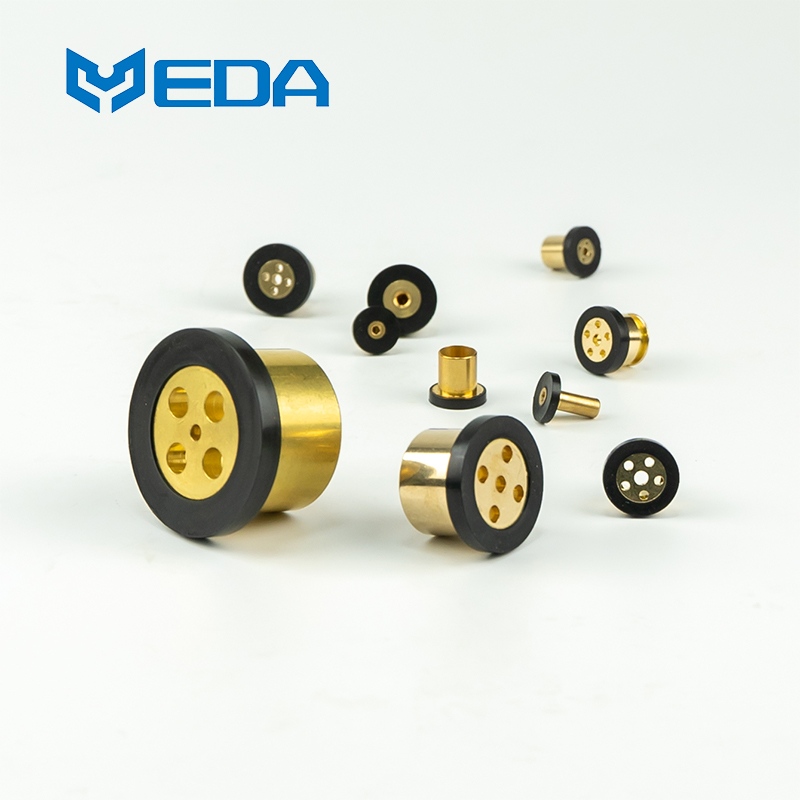
Parker's Integral Seal combines a rigid carrier with a vulcanized rubber element. The supplier lists fewer loose components, visible installation, multi-port sealing and removal of groove machining among possible advantages. Material selection still depends on media, temperature and pressure. [2]
A lighter carrier is not automatically a lighter system if it requires thicker flanges, more fasteners or a large fixture to stay flat. The comparison should include mating hardware and assembly operations, not only the component mass.
An Electronics Gasket Example
Parker Chomerics reports a molded conductive elastomer gasket used to replace a metal gasket and formed-in-place material in an electronic component. The selected material was described as lightweight and capable of environmental sealing and electrical grounding. [3]
The public page does not publish the mass saved or the customer's full qualification. It shows that a custom gasket profile can combine compression, grounding and corrosion requirements, which is a broader form of lightweight integration than simply reducing metal thickness.
Manufacturing Has New Failure Modes
Thin inserts can double-load, shift or bow in the mold. Automated inspection should confirm insert presence, orientation and position before injection. After molding, inspect rubber fill, bond edges, flatness and hole location by cavity.
For rubber to lightweight metal bonding, trace cleaning bath, primer or adhesive lot, surface age and cure conditions. If an insert is rejected, define whether it can be safely stripped and reused. Uncontrolled rework may damage coatings or hide a weak bond.
Release the Joint
Test lightweight automotive sealing with production-intent carrier, housing, fasteners and coatings. Apply torque, pressure, vibration, fluid and thermal cycles in representative order. Measure leak and joint movement, then inspect bond and permanent set after disassembly.
Use tolerance-extreme builds to challenge the seal at minimum and maximum compression. If the carrier is intended to control squeeze, verify its thickness and deformation under bolt load. If a plastic retainer is used, include creep and moisture conditioning.
A second review of bonded elastomer components should consider service. Replacement, cleaning and galvanic-corrosion protection may change when the seal and carrier become one part. The maintenance instruction is part of the integration decision.
The comparison should also preserve a conventional baseline. Measure carrier mass, installed hardware, leak performance, assembly time and damage rate for both designs. This prevents a local weight reduction from being reported as a system benefit when additional brackets or fasteners cancel it.
Where recycling or material separation matters, document how the bonded assembly is handled at end of life. A durable interface that is valuable in service may make separation harder, so the program should define the applicable recovery route without weakening the bond requirement.
Yida can review lightweight rubber metal components when the customer provides carrier material and coating, flange stiffness, fastener pattern, temperature movement, fluids, loads and service method. Those inputs allow mass reduction to be checked against sealing and bond margin.